





 Dr. Mark Van Nydeck Erdmann (Conservation International Advertisement), Indonesien


Info
Eviota stella Greenfield D.W., Erdmann, M.V. & Sianipar, A. (2026)
Starburst dwarfgoby
New dwarfgoby described from West Papua: Eviota stella
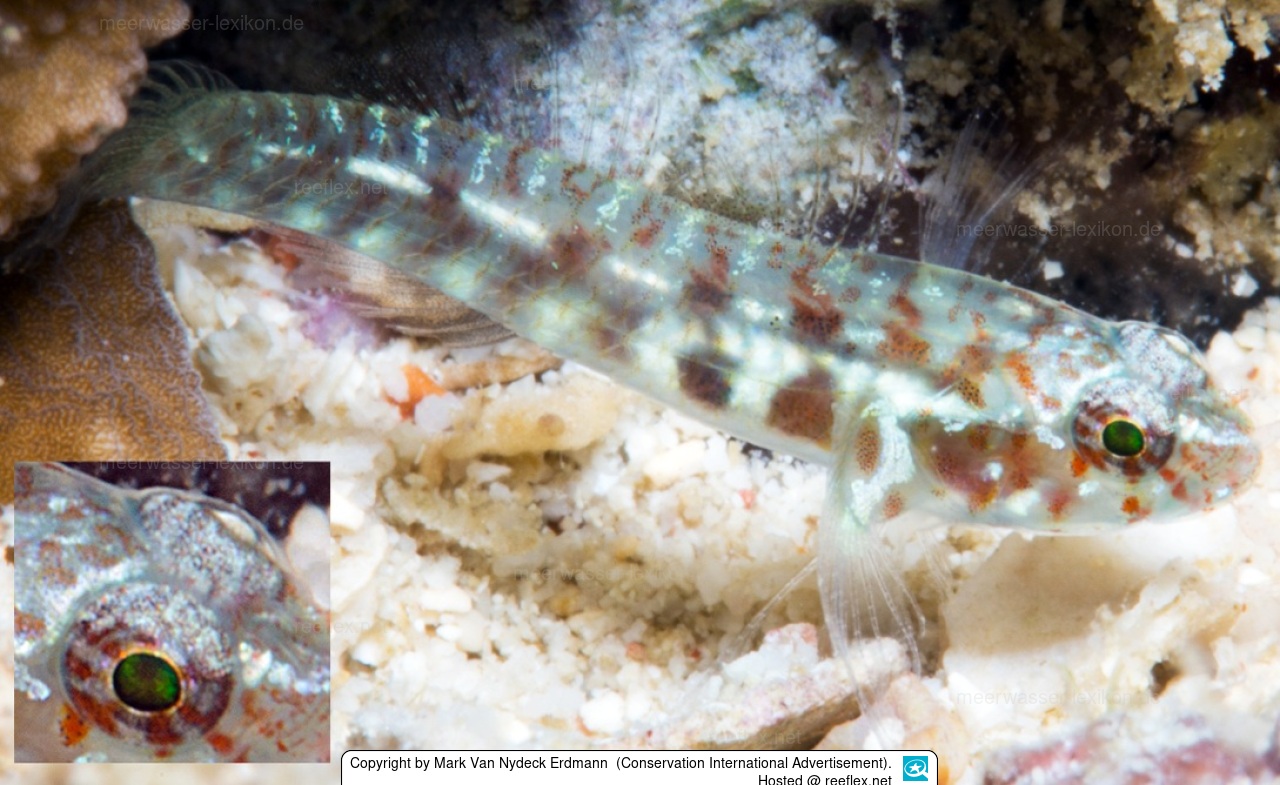
A new species of dwarfgoby, Eviota stella, has been scientifically described from Cenderawasih Bay in West Papua, Indonesia. The species belongs to the goby family Gobiidae. The largest specimen examined had a standard length of approximately 16.6 millimetres. Its description brings the number of recognised species in the genus Eviota to 140.
One of the fish’s most striking features is its eye coloration. The upper part of the iris is densely covered with fine white spots, creating a starburst-like appearance. This feature inspired the species name, as the Latin word “stella” means “star”. The fins are also sprinkled with numerous tiny bluish-white spots.
The body is translucent grey with a slight bluish tint. Two prominent dark spots arranged one above the other are visible on the base of the pectoral fin. The fish also has five dark bars behind the origin of the anal fin. Another important identifying feature is a single dark band across the lower part of the first dorsal fin.
Eviota stella closely resembles the related species Eviota queenslandica and Eviota perspicilla. However, these two species have three oblique dark bands on the first dorsal fin. Eviota queenslandica also possesses an additional round dark spot below the pectoral-fin base, which is absent in Eviota stella.
So far, the new species is known only from Cenderawasih Bay. It was observed on the reef crests of several offshore islands at depths of approximately two to five metres. The fish lives among coral rubble and limestone surfaces in areas that are sometimes exposed to moderate or strong wave surge. Small groups of up to six individuals were frequently observed.
The discovery highlights the remarkable diversity of tiny bottom-dwelling reef fishes. Although dwarfgobies are easily overlooked because of their small size, they play an important role in coral reef ecosystems. They feed on small invertebrates and are themselves an important source of food for larger fishes.
Quick facts
Scientific name: Eviota stella
Common name: Starburst Dwarfgoby
Family: Gobiidae – gobies
Maximum recorded standard length: 16.6 mm
Distribution: Cenderawasih Bay, West Papua, Indonesia
Habitat: Reef crests with coral rubble and limestone surfaces
Recorded depth: 2–5 metres
Social behaviour in the natural habitat: Small groups of up to six individuals
Name origin: From the Latin word stella, meaning “star”, referring to the starburst-like white spots on the iris
The original species description does not provide information on aquarium husbandry, feeding or long-term care. Therefore, no reliable husbandry recommendations should be derived from this scientific paper alone.
Main reference: Greenfield D.W., Erdmann, M.V. & Sianipar, A. (2026) Eviota stella, a new dwarfgoby from West
Papua, Indonesia (Teleostei: Gobiidae). Journal of the Ocean Science Foundation, 47, 1–7.
Starburst dwarfgoby
New dwarfgoby described from West Papua: Eviota stella
A new species of dwarfgoby, Eviota stella, has been scientifically described from Cenderawasih Bay in West Papua, Indonesia. The species belongs to the goby family Gobiidae. The largest specimen examined had a standard length of approximately 16.6 millimetres. Its description brings the number of recognised species in the genus Eviota to 140.
One of the fish’s most striking features is its eye coloration. The upper part of the iris is densely covered with fine white spots, creating a starburst-like appearance. This feature inspired the species name, as the Latin word “stella” means “star”. The fins are also sprinkled with numerous tiny bluish-white spots.
The body is translucent grey with a slight bluish tint. Two prominent dark spots arranged one above the other are visible on the base of the pectoral fin. The fish also has five dark bars behind the origin of the anal fin. Another important identifying feature is a single dark band across the lower part of the first dorsal fin.
Eviota stella closely resembles the related species Eviota queenslandica and Eviota perspicilla. However, these two species have three oblique dark bands on the first dorsal fin. Eviota queenslandica also possesses an additional round dark spot below the pectoral-fin base, which is absent in Eviota stella.
So far, the new species is known only from Cenderawasih Bay. It was observed on the reef crests of several offshore islands at depths of approximately two to five metres. The fish lives among coral rubble and limestone surfaces in areas that are sometimes exposed to moderate or strong wave surge. Small groups of up to six individuals were frequently observed.
The discovery highlights the remarkable diversity of tiny bottom-dwelling reef fishes. Although dwarfgobies are easily overlooked because of their small size, they play an important role in coral reef ecosystems. They feed on small invertebrates and are themselves an important source of food for larger fishes.
Quick facts
Scientific name: Eviota stella
Common name: Starburst Dwarfgoby
Family: Gobiidae – gobies
Maximum recorded standard length: 16.6 mm
Distribution: Cenderawasih Bay, West Papua, Indonesia
Habitat: Reef crests with coral rubble and limestone surfaces
Recorded depth: 2–5 metres
Social behaviour in the natural habitat: Small groups of up to six individuals
Name origin: From the Latin word stella, meaning “star”, referring to the starburst-like white spots on the iris
The original species description does not provide information on aquarium husbandry, feeding or long-term care. Therefore, no reliable husbandry recommendations should be derived from this scientific paper alone.
Main reference: Greenfield D.W., Erdmann, M.V. & Sianipar, A. (2026) Eviota stella, a new dwarfgoby from West
Papua, Indonesia (Teleostei: Gobiidae). Journal of the Ocean Science Foundation, 47, 1–7.


