


 Dr. Mark Van Nydeck Erdmann (Conservation International Advertisement), Indonesien


Info
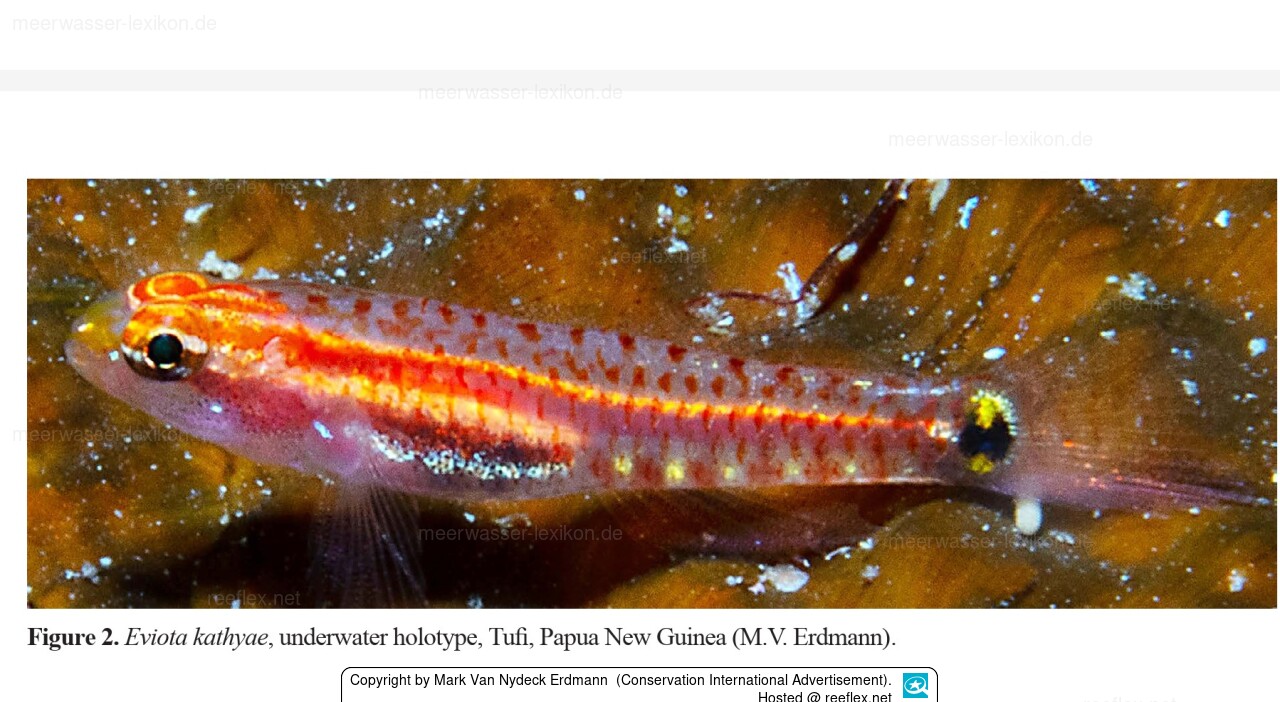
Eviota kathyae
Dwarfgoby
A new species of dwarfgoby, Eviota kathyae, is described from the volcanic fjords of Tufi, Papua New Guinea. The new species is diagnosed by the combination of unbranched pectoral-fin rays, the cephalic sensory-canal pore system lacking only the IT pore, a dorsal/anal fin-formula of 8/7, no fifth pelvic-fin ray, a vertically constricted black blotch at the caudal-fin base, a mostly unmarked caudal fin, and the iris above the pupil crossed by an unbroken red band. The species is likely endemic to this unique habitat formed by collapsed lava flows.
Eviota kathyae shares its overall general color pattern and habitat preference with E. gunawanae and its morphological characters with E. oculineata, both members of the E. zebrina complex (Tornabene et al .2021). Future genetic analyses will likely demonstrate that E. kathyae also belongs to that species complex and is closely related to E. gunawanae. The latter species is found in a similarly unusual environment, also highly protected from wave energy, in Sebakor Bay in Fakfak, West Papua, and was also only observed below 35 m depth (in contrast to E. oculineata, which is regularly found as shallow as 3 m and rarely deeper than 20 m).
Main reference: Greenfield D.W., Brooks, W.M. & Erdmann, M.V. (2026) Eviota kathyae, a new dwarfgoby from the unique volcanic fjords of Tufi, Papua New Guinea (Teleostei: Gobiidae). Journal of the Ocean Science Foundation, 46, 1–8.
Jumping guard
A jumping guard prevents (nocturnal) fish from jumping out.
Wrasses, blennies, hawkfishs and gobies jump out of an unprotected tank in fright if their night rest is disturbed, unfortunately these jumpers are found dried up in the morning on carpets, glass edges or later behind the tank.
https://www.korallenriff.de/en/article/1925_5_Jump_Protection_Solutions_for_Fish_in_the_Aquarium__5_Net_Covers.html
A small night light also helps, as it provides the fish with a means of orientation in the dark!
The term "reef safe" is often used in marine aquaristics, especially when buying a new species people often ask if the new animal is "reef safe".
What exactly does reef safe mean?
To answer this question, you can ask target-oriented questions and inquire in forums, clubs, dealers and with aquarist friends:
- Are there already experiences and keeping reports that assure that the new animal can live in other suitably equipped aquariums without ever having caused problems?
- Is there any experience of invertebrates (crustaceans, hermits, mussels, snails) or corals being attacked by other inhabitants such as fish of the same or a different species?
- Is any information known or expected about a possible change in dietary habits, e.g., from a plant-based diet to a meat-based diet?
- Do the desired animals leave the reef structure "alone", do they constantly change it (boring starfish, digger gobies, parrotfish, triggerfish) and thus disturb or displace other co-inhabitants?
- do new animals tend to get diseases repeatedly and very quickly and can they be treated?
- Do known peaceful animals change their character in the course of their life and become aggressive?
- Can the death of a new animal possibly even lead to the death of the rest of the stock through poisoning (possible with some species of sea cucumbers)?
- Last but not least the keeper of the animals has to be included in the "reef safety", there are actively poisonous, passively poisonous animals, animals that have dangerous biting or stinging weapons, animals with extremely strong nettle poisons, these have to be (er)known and a plan of action should have been made in advance in case of an attack on the aquarist (e.g. telephone numbers of the poison control center, the treating doctor, the tropical institute etc.).
If all questions are evaluated positively in the sense of the animal(s) and the keeper, then one can assume a "reef safety".
Dwarfgoby
A new species of dwarfgoby, Eviota kathyae, is described from the volcanic fjords of Tufi, Papua New Guinea. The new species is diagnosed by the combination of unbranched pectoral-fin rays, the cephalic sensory-canal pore system lacking only the IT pore, a dorsal/anal fin-formula of 8/7, no fifth pelvic-fin ray, a vertically constricted black blotch at the caudal-fin base, a mostly unmarked caudal fin, and the iris above the pupil crossed by an unbroken red band. The species is likely endemic to this unique habitat formed by collapsed lava flows.
Eviota kathyae shares its overall general color pattern and habitat preference with E. gunawanae and its morphological characters with E. oculineata, both members of the E. zebrina complex (Tornabene et al .2021). Future genetic analyses will likely demonstrate that E. kathyae also belongs to that species complex and is closely related to E. gunawanae. The latter species is found in a similarly unusual environment, also highly protected from wave energy, in Sebakor Bay in Fakfak, West Papua, and was also only observed below 35 m depth (in contrast to E. oculineata, which is regularly found as shallow as 3 m and rarely deeper than 20 m).
Main reference: Greenfield D.W., Brooks, W.M. & Erdmann, M.V. (2026) Eviota kathyae, a new dwarfgoby from the unique volcanic fjords of Tufi, Papua New Guinea (Teleostei: Gobiidae). Journal of the Ocean Science Foundation, 46, 1–8.
Jumping guard
A jumping guard prevents (nocturnal) fish from jumping out.
Wrasses, blennies, hawkfishs and gobies jump out of an unprotected tank in fright if their night rest is disturbed, unfortunately these jumpers are found dried up in the morning on carpets, glass edges or later behind the tank.
https://www.korallenriff.de/en/article/1925_5_Jump_Protection_Solutions_for_Fish_in_the_Aquarium__5_Net_Covers.html
A small night light also helps, as it provides the fish with a means of orientation in the dark!
The term "reef safe" is often used in marine aquaristics, especially when buying a new species people often ask if the new animal is "reef safe".
What exactly does reef safe mean?
To answer this question, you can ask target-oriented questions and inquire in forums, clubs, dealers and with aquarist friends:
- Are there already experiences and keeping reports that assure that the new animal can live in other suitably equipped aquariums without ever having caused problems?
- Is there any experience of invertebrates (crustaceans, hermits, mussels, snails) or corals being attacked by other inhabitants such as fish of the same or a different species?
- Is any information known or expected about a possible change in dietary habits, e.g., from a plant-based diet to a meat-based diet?
- Do the desired animals leave the reef structure "alone", do they constantly change it (boring starfish, digger gobies, parrotfish, triggerfish) and thus disturb or displace other co-inhabitants?
- do new animals tend to get diseases repeatedly and very quickly and can they be treated?
- Do known peaceful animals change their character in the course of their life and become aggressive?
- Can the death of a new animal possibly even lead to the death of the rest of the stock through poisoning (possible with some species of sea cucumbers)?
- Last but not least the keeper of the animals has to be included in the "reef safety", there are actively poisonous, passively poisonous animals, animals that have dangerous biting or stinging weapons, animals with extremely strong nettle poisons, these have to be (er)known and a plan of action should have been made in advance in case of an attack on the aquarist (e.g. telephone numbers of the poison control center, the treating doctor, the tropical institute etc.).
If all questions are evaluated positively in the sense of the animal(s) and the keeper, then one can assume a "reef safety".


