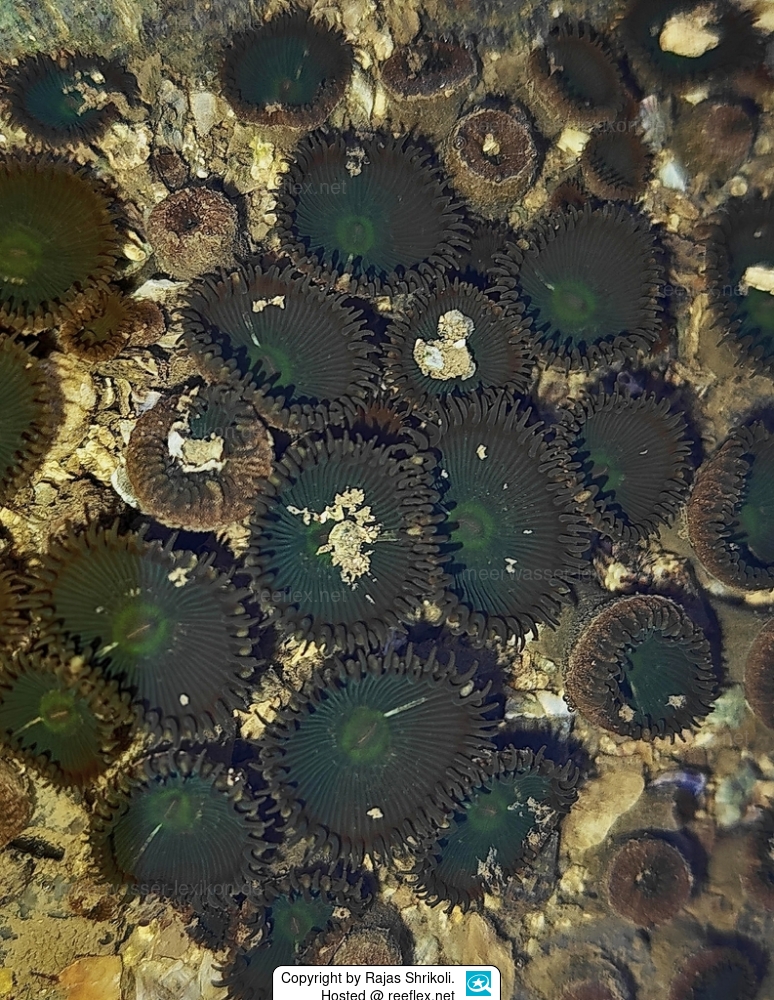
 Rajas Shrikoli, Indien


Info
Palythoa mutuki (Haddon, Shackleton, 1891)
Protopalythoa oder Palythoa is a genus in the Zoanthidae family.
Palythoa mutuki often looks like a cluster of small brown or green anemones along the coasts within its range. It occurs on coral rubble and among seagrasses in large seagrass beds.
Characteristics: Colonies are generally 5–10 cm in size; each polyp has a diameter of about 1–2 cm and a broad oral disc on a long, sturdy body column. Palythoa mutuki has sand on its body, making the body column feel rough to the touch. The broad oral disc has furrows running from the mouth to the edge of the disc. Sometimes it has a white groove, making the disc look as if it were split. Relatively short, tapering tentacles.
The polyps are not embedded in a thick common tissue but are connected at the base by underground stems (called stolons). The long body column raises the oral disc above the shared tissue. Broad zoanthids can reproduce by budding. They occur in small groups ranging from a few to many individuals. The body column is usually beige or brown; the oral disc is usually brown, sometimes in shades of green or light blue.
They contain the highly toxic palytoxin.
Crust anemones are generally easy to keep and usually have no special care requirements. They feed mainly on light, but also on dissolved nutrients and small food particles.
They can therefore thrive in both low- and high-light conditions and often reproduce well. In many cases, they reproduce too well, to the point that they can become competitors to slower-growing corals. Like most crust anemones, this species is quite adaptable. It requires moderate light and low water movement. Some Protopalythoa species can be highly toxic under certain circumstances; please refer to the introduction to this section.
They have green or brown oral discs!
There are several scientific publications describing only very minor genetic differences between Protopalythoa and Palythoa, so a forthcoming revision will clarify whether both genera are valid.