


 John P. Hoover, Hawaii


Info
Unfortunately, there is virtually no information available on the habitat and ecology of this striking little dwarf cichlid.
In the ocean, these species often dart back and forth between rock crevices and coral formations.
This species may also occur on the Socotra Islands (documented as Pseudochromis cf. punctatus: Zajonz et al. 2019), but this has yet to be scientifically verified and confirmed.
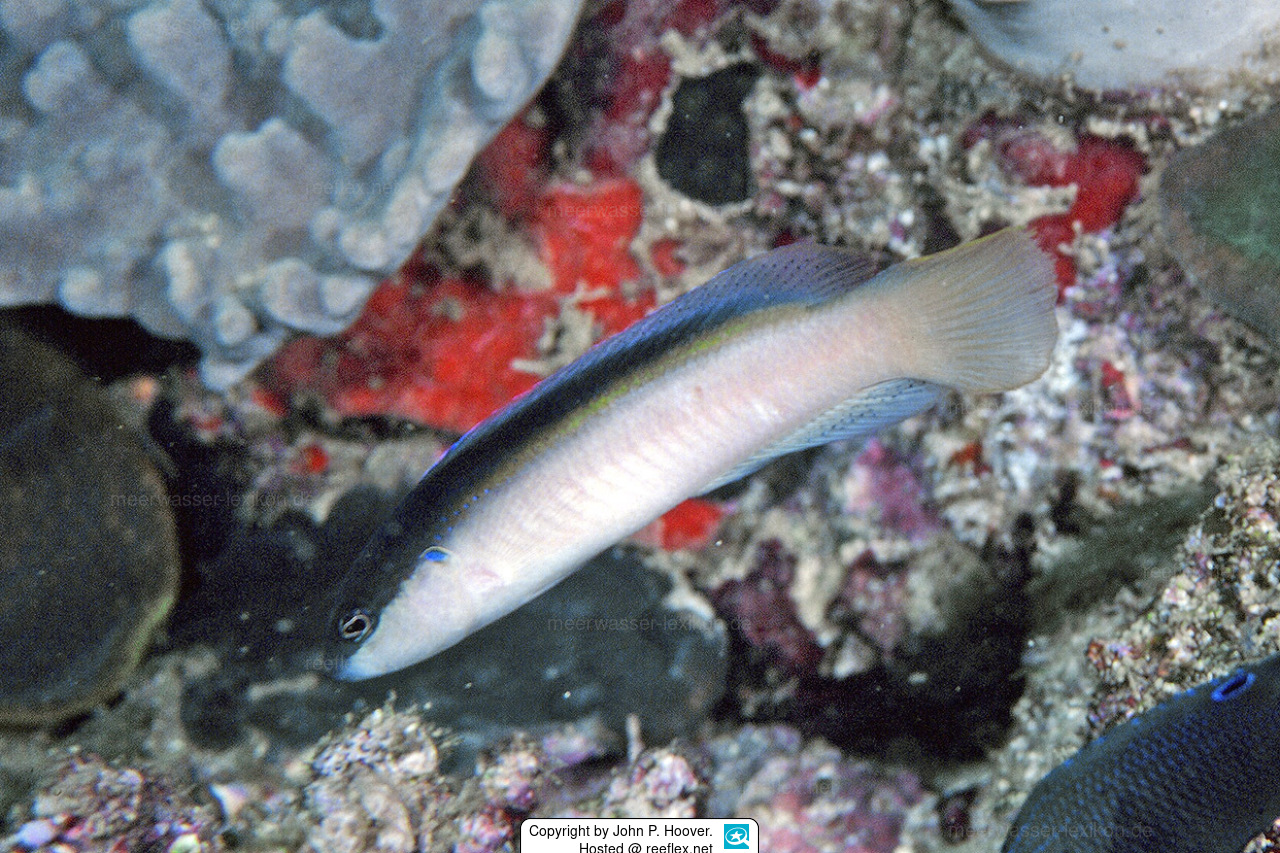
The head and dorsal side of Pseudochromis punctatus are dark gray to black; the sides of the body are brownish-yellow, pale pink, or white, with the two areas separated by a yellow longitudinal stripe.
The dorsal fin is marked with numerous black spots; in larger individuals, dark spots are also present on the anal fin.
The holotype was collected off the coast of Somalia at a depth of 55–65 meters, along with four specimens from the Hallaniyat Islands (also known as the Khuriya-Muriya Islands [Kuria-Muria Islands]), which John L. Earle caught at a depth of 17–21 meters.
Etymology:
The genus name “Pseudochromis” is composed of the Greek words “pseudes” = “false, fake” + “Chromis,” an ancient fish name, likely referring to a perch or a perch-like fish.
The genus name thus means “false Chromis.”
The species name “punctatus” comes from the Latin “punctatus = ‘spotted, dotted’” (from punctum, “point”).
The scientist who first described the species, Kotthaus, based the epithet on the small black spots on the dorsal and anal fins.
Pseudochromis punctatus is closely related to Pseudochromis pesi from the Red Sea and Pseudochromis melas, which is found from Kenya to South Africa.
Synonym: Pseudochromis melanotus Lubbock, 1975 · unaccepted
We would like to extend our special thanks to John P. Hoover, Hawaii, who kindly provided us with his photo taken on Jazirat Al Hallaniyyah, an island in Oman. Malaho, John!
In the ocean, these species often dart back and forth between rock crevices and coral formations.
This species may also occur on the Socotra Islands (documented as Pseudochromis cf. punctatus: Zajonz et al. 2019), but this has yet to be scientifically verified and confirmed.
The head and dorsal side of Pseudochromis punctatus are dark gray to black; the sides of the body are brownish-yellow, pale pink, or white, with the two areas separated by a yellow longitudinal stripe.
The dorsal fin is marked with numerous black spots; in larger individuals, dark spots are also present on the anal fin.
The holotype was collected off the coast of Somalia at a depth of 55–65 meters, along with four specimens from the Hallaniyat Islands (also known as the Khuriya-Muriya Islands [Kuria-Muria Islands]), which John L. Earle caught at a depth of 17–21 meters.
Etymology:
The genus name “Pseudochromis” is composed of the Greek words “pseudes” = “false, fake” + “Chromis,” an ancient fish name, likely referring to a perch or a perch-like fish.
The genus name thus means “false Chromis.”
The species name “punctatus” comes from the Latin “punctatus = ‘spotted, dotted’” (from punctum, “point”).
The scientist who first described the species, Kotthaus, based the epithet on the small black spots on the dorsal and anal fins.
Pseudochromis punctatus is closely related to Pseudochromis pesi from the Red Sea and Pseudochromis melas, which is found from Kenya to South Africa.
Synonym: Pseudochromis melanotus Lubbock, 1975 · unaccepted
We would like to extend our special thanks to John P. Hoover, Hawaii, who kindly provided us with his photo taken on Jazirat Al Hallaniyyah, an island in Oman. Malaho, John!

