

 Journal of the Ocean Science Foundation


Info
The 12th species of the genus Fusigobius was discovered 2024 around Taiping Island in the South China Sea at depths of around 15 meters, which are easily accessible to divers.
The following species of the genus are currently recognized, but it is likely that additional species will be described in the future.
Fusigobius aureus
Fusigobius duospilus
Fusigobius gracilis
Fusigobius humeralis
Fusigobius inframaculatus
Fusigobius longispinus
Fusigobius maximus
Fusigobius melacron
Fusigobius neophytus
Fusigobius pallidus
Fusigobius signipinnis
Fusigobius taipinensis
Description:
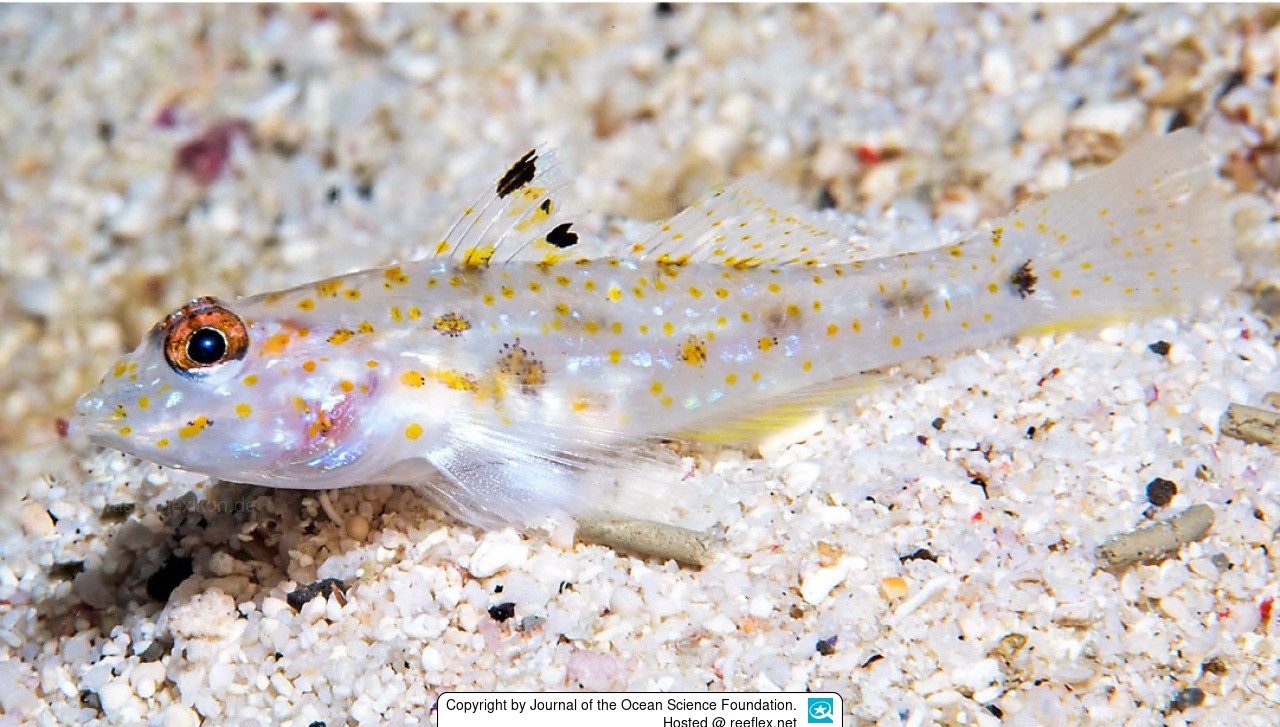
The goby’s body and head are semi-transparent and feature small, bright yellow, round spots and a few tiny white dots.
A row of discontinuous yellow spots runs from the lower edge of the eye socket to the upper lip.
The cheek bears a similar, parallel row of yellow markings.
At the base of the pectoral fin are two bright yellow, round spots with a white central stripe.
The lateral midline on the body features a horizontal row of 8–9 bright yellow spots, each smaller than the pupil.
The rest of the body is dotted with smaller, round yellow spots.
At the base of the caudal fin is a centrally located, triangular, yellow to grayish-yellow mark.
The first dorsal fin has a deep black spot in the upper quarter in front of the third spiny ray; in the upper half between the fifth and sixth spiny rays, there is a smaller, elongated, deep black mark, and its membrane is dotted with several small yellow spots and some gray to black dots.
The second dorsal fin has 3–4 rows of tiny yellow, round spots.
The pelvic fins are somewhat translucent and dotted with tiny white spots.
The anal fin has a few small yellow spots in the outer two-thirds and a few tiny white dots at the base.
The caudal fin is translucent and bears three main rows of small yellow spots arranged in a radial pattern.
Similar species:
Fusigobius taipinensis is morphologically closely related to Fusigobius duospilus, but can be clearly distinguished by several key coloration characteristics on the first dorsal fin or on the body.
Etymology.
The species name “taipinensis” refers to the type locality, Taiping Island, the largest island of the Republic of China (Taiwan), located near the Nansha Islands in the South China Sea. The newly described species is more common there than any other Fusigobius species collected on the island.
This region could also serve as an important habitat for this species.
In contrast, although the species also occurs in southern Taiwan, it is actually very rare compared to all other species observed among members of its genus.
Source:
CHEN, I-SHIUNG & CHEN, KUAN-TE & Yang, Yen-Cheng & Harefa, Tonisman & Chou, Li-Chin & Shen, Kang-Ning & Chang, Chih-Wei. (2024). Taxonomic review and molecular phylogenetics of the reef gobiid genus Fusigobius from Taiwan with comments on a new species from South China Sea. Zootaxa. 5550. 17-31. 10.11646/zootaxa.5550.1.5.
The following species of the genus are currently recognized, but it is likely that additional species will be described in the future.
Fusigobius aureus
Fusigobius duospilus
Fusigobius gracilis
Fusigobius humeralis
Fusigobius inframaculatus
Fusigobius longispinus
Fusigobius maximus
Fusigobius melacron
Fusigobius neophytus
Fusigobius pallidus
Fusigobius signipinnis
Fusigobius taipinensis
Description:
The goby’s body and head are semi-transparent and feature small, bright yellow, round spots and a few tiny white dots.
A row of discontinuous yellow spots runs from the lower edge of the eye socket to the upper lip.
The cheek bears a similar, parallel row of yellow markings.
At the base of the pectoral fin are two bright yellow, round spots with a white central stripe.
The lateral midline on the body features a horizontal row of 8–9 bright yellow spots, each smaller than the pupil.
The rest of the body is dotted with smaller, round yellow spots.
At the base of the caudal fin is a centrally located, triangular, yellow to grayish-yellow mark.
The first dorsal fin has a deep black spot in the upper quarter in front of the third spiny ray; in the upper half between the fifth and sixth spiny rays, there is a smaller, elongated, deep black mark, and its membrane is dotted with several small yellow spots and some gray to black dots.
The second dorsal fin has 3–4 rows of tiny yellow, round spots.
The pelvic fins are somewhat translucent and dotted with tiny white spots.
The anal fin has a few small yellow spots in the outer two-thirds and a few tiny white dots at the base.
The caudal fin is translucent and bears three main rows of small yellow spots arranged in a radial pattern.
Similar species:
Fusigobius taipinensis is morphologically closely related to Fusigobius duospilus, but can be clearly distinguished by several key coloration characteristics on the first dorsal fin or on the body.
Etymology.
The species name “taipinensis” refers to the type locality, Taiping Island, the largest island of the Republic of China (Taiwan), located near the Nansha Islands in the South China Sea. The newly described species is more common there than any other Fusigobius species collected on the island.
This region could also serve as an important habitat for this species.
In contrast, although the species also occurs in southern Taiwan, it is actually very rare compared to all other species observed among members of its genus.
Source:
CHEN, I-SHIUNG & CHEN, KUAN-TE & Yang, Yen-Cheng & Harefa, Tonisman & Chou, Li-Chin & Shen, Kang-Ning & Chang, Chih-Wei. (2024). Taxonomic review and molecular phylogenetics of the reef gobiid genus Fusigobius from Taiwan with comments on a new species from South China Sea. Zootaxa. 5550. 17-31. 10.11646/zootaxa.5550.1.5.

