




 Acta Ichthyologica et Piscatoria


Info
Synchiropus monacanthus was originally described based on a holotype collected in Port Alfred, South Africa, in the western Indian Ocean
Due to its considerable depth of distribution, understandably little is known about the lyrefish.
The lyrefish has been caught primarily in nets along the African coast from South Africa north to Yemen and around Madagascar.
It is quite a feat for such small and not particularly strong swimmers to be “suddenly” detected in Palk Bay in southeastern India via trawl fishing.
Six specimens of the species, all females, were landed there on March 9, 2025.
How the lyrefish were able to cover such an extremely long distance remains unclear.
Their presence in the Palk Bay region suggests that the distribution of Synchiropus monacanthus along the northern Indian Ocean may be more continuous than previously assumed, and that the species may have been overlooked in this region due to its deep-sea habitat and the difficulties of sampling in such environments.
It is also interesting that the previously known shallowest occurrence of the species in India, at 175 meters, has been revised to 100 meters.
The discovery of Synchiropus monacanthus underscores the importance of examining bycatch from trawl nets in deeper waters and highlights that the diversity of dragonfish in this region of the Indian Ocean is still not fully understood.
According to WoRMS, the species is said to be abundant in the upper reaches of estuaries.
Brief description:
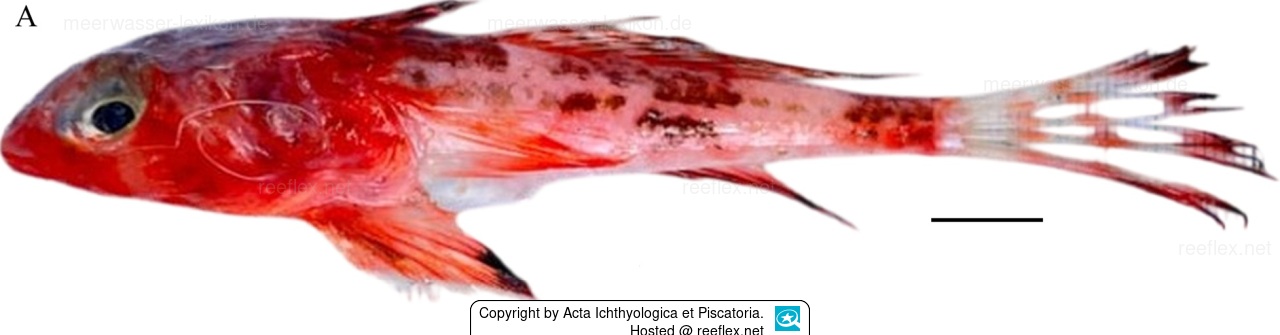
The head and body of Synchiropus monacanthus are dark red, marbled, and speckled with darker pigments.
The second dorsal and anal fins have dark tips, and the caudal fin is marked with three vertical white bands and a dark edge at the tip.
The pelvic fin is dark at the tip.
The first dorsal fin is light red, the first spine black with dark spots at the base
Due to its considerable depth of distribution, understandably little is known about the lyrefish.
The lyrefish has been caught primarily in nets along the African coast from South Africa north to Yemen and around Madagascar.
It is quite a feat for such small and not particularly strong swimmers to be “suddenly” detected in Palk Bay in southeastern India via trawl fishing.
Six specimens of the species, all females, were landed there on March 9, 2025.
How the lyrefish were able to cover such an extremely long distance remains unclear.
Their presence in the Palk Bay region suggests that the distribution of Synchiropus monacanthus along the northern Indian Ocean may be more continuous than previously assumed, and that the species may have been overlooked in this region due to its deep-sea habitat and the difficulties of sampling in such environments.
It is also interesting that the previously known shallowest occurrence of the species in India, at 175 meters, has been revised to 100 meters.
The discovery of Synchiropus monacanthus underscores the importance of examining bycatch from trawl nets in deeper waters and highlights that the diversity of dragonfish in this region of the Indian Ocean is still not fully understood.
According to WoRMS, the species is said to be abundant in the upper reaches of estuaries.
Brief description:
The head and body of Synchiropus monacanthus are dark red, marbled, and speckled with darker pigments.
The second dorsal and anal fins have dark tips, and the caudal fin is marked with three vertical white bands and a dark edge at the tip.
The pelvic fin is dark at the tip.
The first dorsal fin is light red, the first spine black with dark spots at the base

