


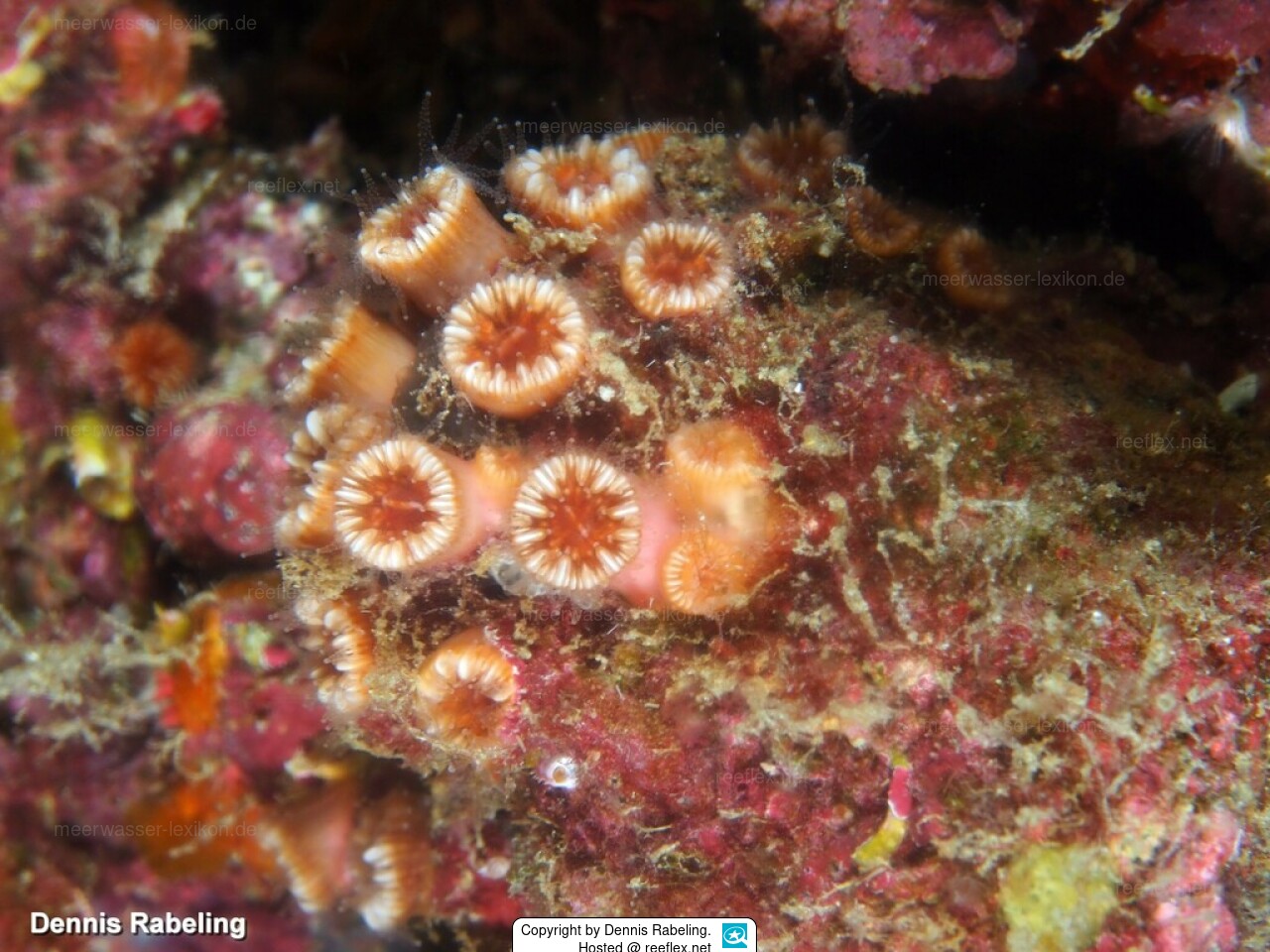
 Dennis Rabeling, Lanzarote, Kanarischen Inseln


Info
Polycyathus muellerae (Abel, 1959)
Polycyathus muellerae is a small coral species in the family Caryophylliidae, order Scleractinia, class Anthozoa. It is native to the northeast Atlantic and the Mediterranean. It is a colonial coral with large polyps that grows under overhangs and in caves as part of a collection of organisms adapted to these poorly lit locations. It usually avoids direct sunlight and grows in caves and under overhangs.
A study of the communities of organisms living in caves in southern Italy showed that the best-lit areas near the entrance had abundant algae, while the deepest parts were dominated by sponges. The intermediate zone contained corals including serpulids, hydroids, serpulids, clams, worm snails, bryozoans and sea squirts.
The rather diffuse colonies can reach a diameter of about one meter. Each individual polyp sits in a coralite with a diameter of about 6 mm and a height of 10 mm. The coralites have up to four cycles of serrated septa (stone ridges), making a total of 48 septa. Both coralites and polyps are brown, and the 3–4 mm long tentacles have white granulations and white cylindrical tips.
Polycyathus muellerae is a non-zooxanthellate coral; it has no symbiotic relationship with microscopic dinoflagellates like most corals, but gets all its nutrition from planktonic organisms captured by the polyps.
Asexual reproduction by budding enlarges the colony. Sexual reproduction has not been observed in this species, but the fact that the coral is widespread suggests that it probably occurs.
It is sometimes parasitized by the barnacle Megatrema anglicum.
Synonymised names
Cladocora caespitosa f. incrostante Rossi, 1957 · unaccepted > junior subjective synonym
Cladocora caespitosa var. mulleri Abel, 1959 · unaccepted > superseded combination
Cladocora cespitosa var. mulleri Abel, 1959 · unaccepted > superseded combination
Cladocora muellerae Abel, 1959 · unaccepted > superseded combination
Polycyathus banyulensis Best, 1968 · unaccepted > junior subjective synonym
Polycyathus mediterraneus Best, 1968 · unaccepted > junior subjective synonym
Polycyathus muellerae is a small coral species in the family Caryophylliidae, order Scleractinia, class Anthozoa. It is native to the northeast Atlantic and the Mediterranean. It is a colonial coral with large polyps that grows under overhangs and in caves as part of a collection of organisms adapted to these poorly lit locations. It usually avoids direct sunlight and grows in caves and under overhangs.
A study of the communities of organisms living in caves in southern Italy showed that the best-lit areas near the entrance had abundant algae, while the deepest parts were dominated by sponges. The intermediate zone contained corals including serpulids, hydroids, serpulids, clams, worm snails, bryozoans and sea squirts.
The rather diffuse colonies can reach a diameter of about one meter. Each individual polyp sits in a coralite with a diameter of about 6 mm and a height of 10 mm. The coralites have up to four cycles of serrated septa (stone ridges), making a total of 48 septa. Both coralites and polyps are brown, and the 3–4 mm long tentacles have white granulations and white cylindrical tips.
Polycyathus muellerae is a non-zooxanthellate coral; it has no symbiotic relationship with microscopic dinoflagellates like most corals, but gets all its nutrition from planktonic organisms captured by the polyps.
Asexual reproduction by budding enlarges the colony. Sexual reproduction has not been observed in this species, but the fact that the coral is widespread suggests that it probably occurs.
It is sometimes parasitized by the barnacle Megatrema anglicum.
Synonymised names
Cladocora caespitosa f. incrostante Rossi, 1957 · unaccepted > junior subjective synonym
Cladocora caespitosa var. mulleri Abel, 1959 · unaccepted > superseded combination
Cladocora cespitosa var. mulleri Abel, 1959 · unaccepted > superseded combination
Cladocora muellerae Abel, 1959 · unaccepted > superseded combination
Polycyathus banyulensis Best, 1968 · unaccepted > junior subjective synonym
Polycyathus mediterraneus Best, 1968 · unaccepted > junior subjective synonym


