Anne Frijsinger & Mat Vestjens, Holland

Info
Ectyoplasia ferox (Duchassaing & Michelotti, 1864)
Description:
The sponge grows in two habits:
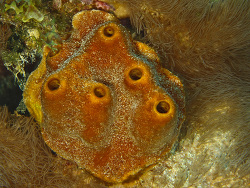
(a) Thickly incrusting, with oscules on top of hemispherical or low conical projections; up to 5 cm thick, with a spread of 30 cm or more (E. ferox habitus).
(b) Massive, erect, often compressed, thickly flabellate, with oscules on lateral, horizontally projecting elevations, and on terminal erect chimneys, which are like turrets, connected by sharply edged crests. The erect chimneys may take over almost completely, clustering, coalescent, up to 10 cm long, gradually tapering, surpassing the connecting ridges.
The oscules in both types are 2-7 mm wide, provided with a recessed, plane, contractile diaphragm. The surface has a felt-like texture; the consistency is spongy, compressible, resilient and easily torn.
Color:
The color is externally a rich brownish orange; internally yellow-orange.
Habitat:
Inhabit reefs and adjacent areas. Often grow over coral rubble and dead areas of the reef.
Distribution:
Occasional Florida Keys; common in the Bahamas and Caribbean.
Source: Marine Species Identification Portal
Synonymised names
Amphimedon ferox Duchassaing & Michelotti, 1864 · unaccepted (genus transfer)
Ectyoplasia ferox surgens Wiedenmayer, 1977 · unaccepted (junior synonym)
Ectyoplasia surgens Wiedenmayer, 1977 · unaccepted (junior synonym)
Hemectyon ferox (Duchassaing & Michelotti, 1864) · unaccepted
Hymeniacidon amphilecta de Laubenfels, 1936 · unaccepted (genus transfer and junior synonym)
Direct children (2)
Subspecies Ectyoplasia ferox explicata Wiedenmayer, 1977 accepted as Dragmacidon reticulatum (Ridley & Dendy, 1886) (genus transfer and status change)
Subspecies Ectyoplasia ferox surgens Wiedenmayer, 1977 accepted as Ectyoplasia ferox (Duchassaing & Michelotti, 1864) (junior synonym)
Description:
The sponge grows in two habits:
(a) Thickly incrusting, with oscules on top of hemispherical or low conical projections; up to 5 cm thick, with a spread of 30 cm or more (E. ferox habitus).
(b) Massive, erect, often compressed, thickly flabellate, with oscules on lateral, horizontally projecting elevations, and on terminal erect chimneys, which are like turrets, connected by sharply edged crests. The erect chimneys may take over almost completely, clustering, coalescent, up to 10 cm long, gradually tapering, surpassing the connecting ridges.
The oscules in both types are 2-7 mm wide, provided with a recessed, plane, contractile diaphragm. The surface has a felt-like texture; the consistency is spongy, compressible, resilient and easily torn.
Color:
The color is externally a rich brownish orange; internally yellow-orange.
Habitat:
Inhabit reefs and adjacent areas. Often grow over coral rubble and dead areas of the reef.
Distribution:
Occasional Florida Keys; common in the Bahamas and Caribbean.
Source: Marine Species Identification Portal
Synonymised names
Amphimedon ferox Duchassaing & Michelotti, 1864 · unaccepted (genus transfer)
Ectyoplasia ferox surgens Wiedenmayer, 1977 · unaccepted (junior synonym)
Ectyoplasia surgens Wiedenmayer, 1977 · unaccepted (junior synonym)
Hemectyon ferox (Duchassaing & Michelotti, 1864) · unaccepted
Hymeniacidon amphilecta de Laubenfels, 1936 · unaccepted (genus transfer and junior synonym)
Direct children (2)
Subspecies Ectyoplasia ferox explicata Wiedenmayer, 1977 accepted as Dragmacidon reticulatum (Ridley & Dendy, 1886) (genus transfer and status change)
Subspecies Ectyoplasia ferox surgens Wiedenmayer, 1977 accepted as Ectyoplasia ferox (Duchassaing & Michelotti, 1864) (junior synonym)