

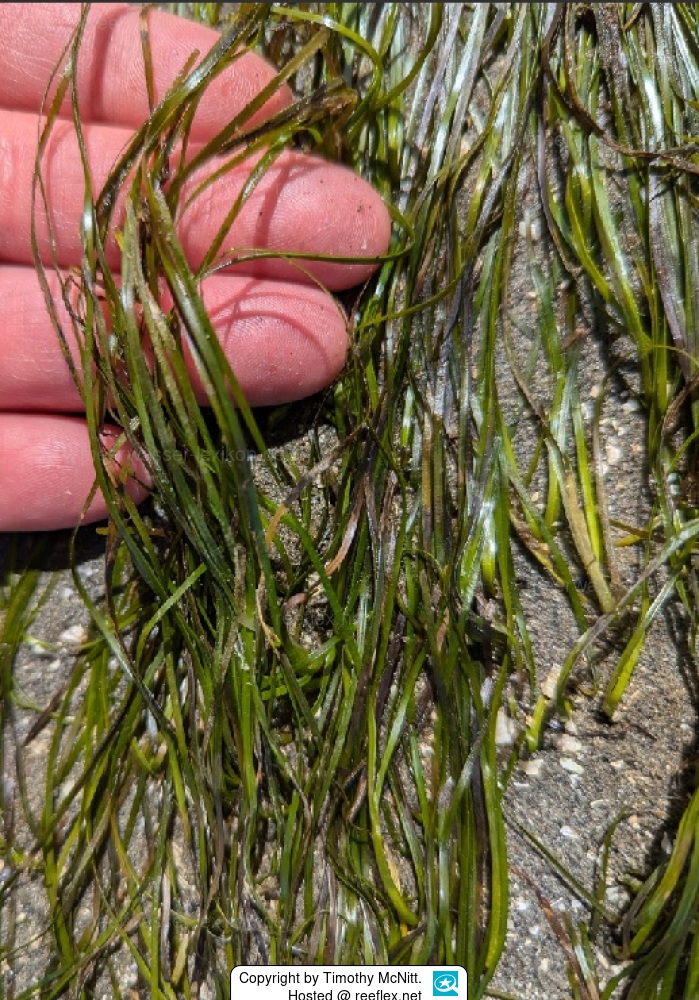
 Timothy McNitt, USA


Info
Zostera japonica quickly becomes a dominant seagrass species in the areas where it occurs, playing an important role in the marine and estuarine ecosystems as a nursery for fish, a feeding ground for sea turtles, and a producer of oxygen.
One reason for the proliferation of this small seagrass may be the fact that Zostera japonica can reproduce both sexually and asexually.
The reproductive shoots of this dwarf seagrass are sparsely branched but can grow up to 30 cm long!
In addition to its positive characteristics, however, the seagrass can have negative effects on mussel farming and harvests for the mussel industry, as is the case in Washington, in the eastern Pacific.
A particularly common inhabitant of the Zostera japonica seagrass beds is the goby Redigobius bikolanus (Herre, 1927).
Synonyms:
Nanozostera americana (Hartog) Tomlinson & Posluszny, 2001 · unaccepted > junior subjective synonym (synonym)
Nanozostera japonica (Ascherson & Graebner) Tomlinson & Posluszny, 2001 · unaccepted > junior objective synonym
Zostera americana Hartog, 1970 · unaccepted (synonym)
Zostera americana den Hartog, 1970 · alternative representation
Zostera japonica Ascherson & Graebner, 1907 · alternative representation
Zostera japonica subsp. austroasiatica Ohba & Miyata · unaccepted > junior objective synonym
One reason for the proliferation of this small seagrass may be the fact that Zostera japonica can reproduce both sexually and asexually.
The reproductive shoots of this dwarf seagrass are sparsely branched but can grow up to 30 cm long!
In addition to its positive characteristics, however, the seagrass can have negative effects on mussel farming and harvests for the mussel industry, as is the case in Washington, in the eastern Pacific.
A particularly common inhabitant of the Zostera japonica seagrass beds is the goby Redigobius bikolanus (Herre, 1927).
Synonyms:
Nanozostera americana (Hartog) Tomlinson & Posluszny, 2001 · unaccepted > junior subjective synonym (synonym)
Nanozostera japonica (Ascherson & Graebner) Tomlinson & Posluszny, 2001 · unaccepted > junior objective synonym
Zostera americana Hartog, 1970 · unaccepted (synonym)
Zostera americana den Hartog, 1970 · alternative representation
Zostera japonica Ascherson & Graebner, 1907 · alternative representation
Zostera japonica subsp. austroasiatica Ohba & Miyata · unaccepted > junior objective synonym

