


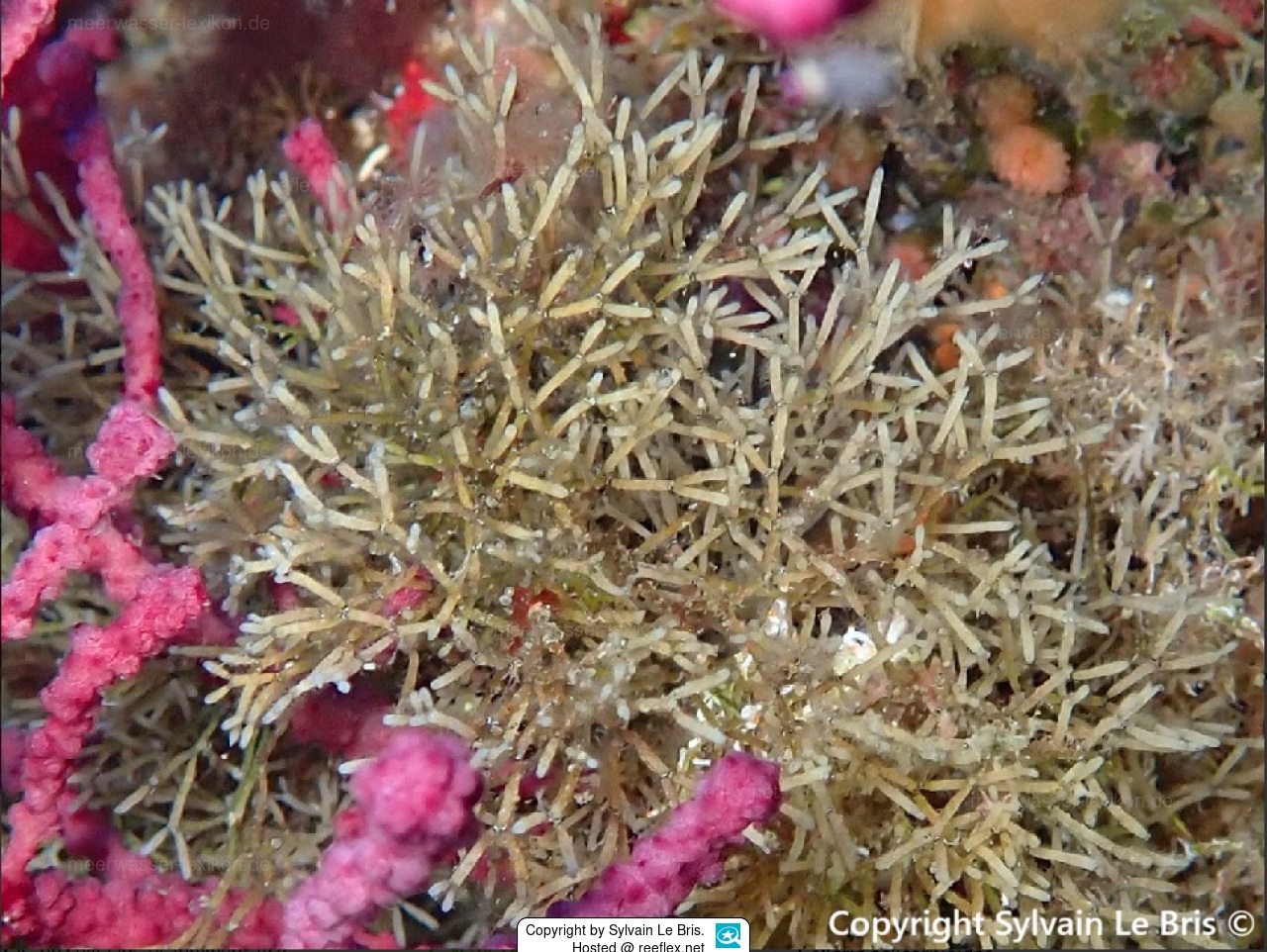
 Sylvain Le Bris, Frankreich


Info
Cellaria salicornioides is an upright moss animal that grows to a maximum height of 5 cm; it is white and consists of slender, segmented, dichotomously branched stems.
The internodes are often 4–8 mm long and 0.2–0.5 mm thick, generally cylindrical, though sometimes they thicken toward the tip and become club-shaped.
The autozooids are typically hexagonal or oval in outline and arranged in alternating rows around the branch.
Successive autozooids in longitudinal rows are widely spaced.
The opesia is barely larger than the operculum, which is semicircular, has a raised proximal margin, and features two proximolateral condyles.
The avicularia occur only occasionally and are the same size as the autozooids they replace.
Synonyms:
Cellaria johnsoni Busk · unaccepted (synonym)
Cellaria salicornioides var. normani Hastings, 1947 · unaccepted (Subjective synonym)
Cellaria savignyi d'Orbigny, 1851 · unaccepted (Subjective synonym)
The internodes are often 4–8 mm long and 0.2–0.5 mm thick, generally cylindrical, though sometimes they thicken toward the tip and become club-shaped.
The autozooids are typically hexagonal or oval in outline and arranged in alternating rows around the branch.
Successive autozooids in longitudinal rows are widely spaced.
The opesia is barely larger than the operculum, which is semicircular, has a raised proximal margin, and features two proximolateral condyles.
The avicularia occur only occasionally and are the same size as the autozooids they replace.
Synonyms:
Cellaria johnsoni Busk · unaccepted (synonym)
Cellaria salicornioides var. normani Hastings, 1947 · unaccepted (Subjective synonym)
Cellaria savignyi d'Orbigny, 1851 · unaccepted (Subjective synonym)


