




 Journal of the Ocean Science Foundation


Info
In Milne Bay Province, Papua New Guinea, Hemiscyllium dudgeonae was discovered and documented around the Amphlett Islands, Yabwaia Island (Bituma), Watota Island (Nubwageta), the Trobriand Islands, and Munuwata Island in the Solomon Sea.
The small epaulette sharks were usually found in very shallow water at night and at greater depths during the day.
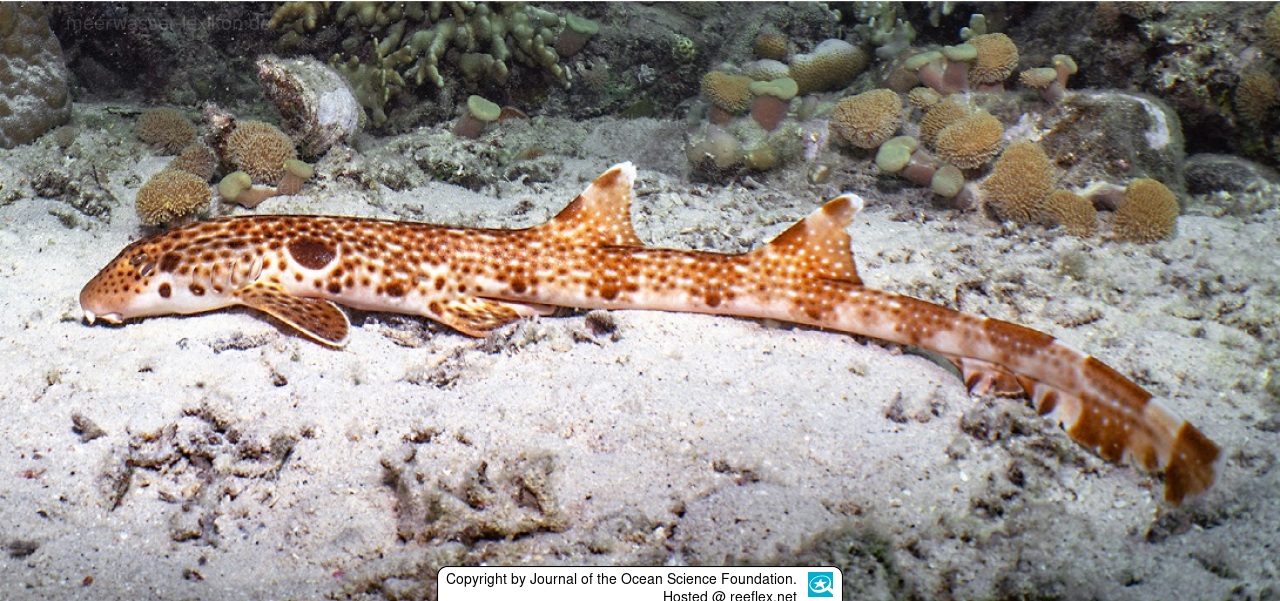
The coloration of the animals is generally brownish-brown, fading to pure white on the ventral side.
They exhibit a dense pattern of brown and white spots as well as white streaks on the head and most of the body, which become less conspicuous toward the tail.
There are approximately 38–48 brown spots on the snout, 11 or 12 brown spots between the eyes, about 30 brown spots on the upper surface of each pectoral fin, and about 15 spots on each pelvic fin.
The brown spots on the head and body generally increase in size from the snout backward toward the anterior regions of the dorsal and pelvic fins, and then gradually become smaller.
The distinctive, intensely dark brown markings include a large (larger than the eye) spot behind the gill openings and a slightly smaller spot below it on the cheek, surrounded by a white area with a well-developed, white-rimmed postcephalic ocellus, as well as a ventral row of 7 widely spaced dark brown spots:
the first below the postcephalic ocellus, the second a short distance in front of the base of the pelvic fin, the third below the frontmost part of the first dorsal fin, the fourth below the free edge of the first dorsal fin, the fifth below the base of the second dorsal fin, the sixth below the free edge of the second dorsal fin, and the seventh slightly in front of the base of the anal fin.
A series of 7 brown saddle- or stripe-like patterns, which are sometimes distinct but often only faintly visible, with intense dark spots forming the ventral end of each stripe or saddle.
Two or three prominent dark brown, saddle-like markings with white areas in between run along the leading edge of both dorsal fins.
The tips of both dorsal fins are white; the caudal fin and the adjacent anal fin feature three brown stripes with broad, whitish areas in between, each of which contains a large brown spot along its anterior margin.
Etymology:
It is a pleasure for the authors to name this strikingly patterned species in honor of Christine L. Dudgeon—a renowned geneticist and ecologist in the field of elasmobranchs who has been researching the phylogeny and speciation of Hemiscyllium for two decades and who first collected this previously undescribed species.
The local common name at the type locality is “kadedekedewa,” which loosely translates to “dog shark” or “lazy shark” and refers to its slow, four-step gait.
In the Trobriand Islands, it is known as “botabota.”
Reference:
Citation: Blakeway, J.-A., Townsend, K.A., Erdmann, M.V., Allen, G.R., Teliwa, M., Waranaka, J.A., Brooks,
W.M. & Dudgeon, C.L. (2026) A review of walking shark (Hemiscylliidae: Hemiscyllium) distributions in Papua
New Guinea and description of a new species. Journal of the Ocean Science Foundation, 46, 71–110.
doi: https://doi.org/10.5281/zenodo.20575429
urn:lsid:zoobank.org:pub:F4D70E42-872D-4351-8F8A-445AB5A00CB2
The small epaulette sharks were usually found in very shallow water at night and at greater depths during the day.
The coloration of the animals is generally brownish-brown, fading to pure white on the ventral side.
They exhibit a dense pattern of brown and white spots as well as white streaks on the head and most of the body, which become less conspicuous toward the tail.
There are approximately 38–48 brown spots on the snout, 11 or 12 brown spots between the eyes, about 30 brown spots on the upper surface of each pectoral fin, and about 15 spots on each pelvic fin.
The brown spots on the head and body generally increase in size from the snout backward toward the anterior regions of the dorsal and pelvic fins, and then gradually become smaller.
The distinctive, intensely dark brown markings include a large (larger than the eye) spot behind the gill openings and a slightly smaller spot below it on the cheek, surrounded by a white area with a well-developed, white-rimmed postcephalic ocellus, as well as a ventral row of 7 widely spaced dark brown spots:
the first below the postcephalic ocellus, the second a short distance in front of the base of the pelvic fin, the third below the frontmost part of the first dorsal fin, the fourth below the free edge of the first dorsal fin, the fifth below the base of the second dorsal fin, the sixth below the free edge of the second dorsal fin, and the seventh slightly in front of the base of the anal fin.
A series of 7 brown saddle- or stripe-like patterns, which are sometimes distinct but often only faintly visible, with intense dark spots forming the ventral end of each stripe or saddle.
Two or three prominent dark brown, saddle-like markings with white areas in between run along the leading edge of both dorsal fins.
The tips of both dorsal fins are white; the caudal fin and the adjacent anal fin feature three brown stripes with broad, whitish areas in between, each of which contains a large brown spot along its anterior margin.
Etymology:
It is a pleasure for the authors to name this strikingly patterned species in honor of Christine L. Dudgeon—a renowned geneticist and ecologist in the field of elasmobranchs who has been researching the phylogeny and speciation of Hemiscyllium for two decades and who first collected this previously undescribed species.
The local common name at the type locality is “kadedekedewa,” which loosely translates to “dog shark” or “lazy shark” and refers to its slow, four-step gait.
In the Trobriand Islands, it is known as “botabota.”
Reference:
Citation: Blakeway, J.-A., Townsend, K.A., Erdmann, M.V., Allen, G.R., Teliwa, M., Waranaka, J.A., Brooks,
W.M. & Dudgeon, C.L. (2026) A review of walking shark (Hemiscylliidae: Hemiscyllium) distributions in Papua
New Guinea and description of a new species. Journal of the Ocean Science Foundation, 46, 71–110.
doi: https://doi.org/10.5281/zenodo.20575429
urn:lsid:zoobank.org:pub:F4D70E42-872D-4351-8F8A-445AB5A00CB2


