




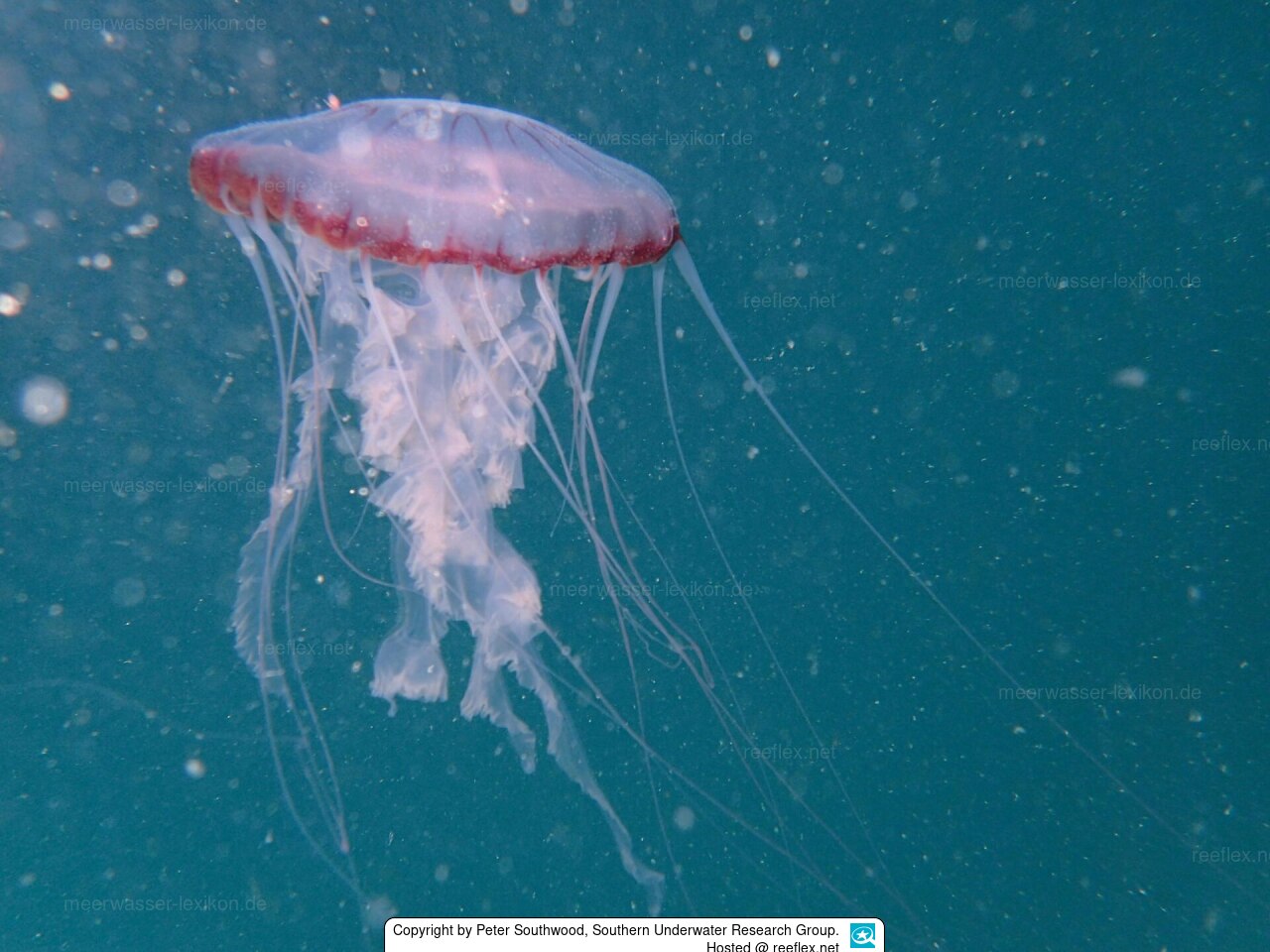
 Peter Southwood, Southern Underwater Research Group, Australien


Info
The Benguela Current, a cold ocean current originating in Antarctic waters in the South Atlantic, brings nutrient-rich deep water to the surface off the coast of Namibia. The Benguela compass jellyfish is found in this highly productive marine region, and its range extends as far as South Africa.
The Benguela compass jellyfish (Chrysaora fulgida) is one of three closely related species, some of which are endemic to the South African coast.
The diameter of its bell can reach up to 80 cm, which is very large for a jellyfish.
From the tip of its head to the end of its fringed tentacles, it can reach a length of just over 2 meters.
The sting of the Benguela compass jellyfish is only about as painful as a bee sting and therefore not particularly dangerous to humans.
Compass jellyfish change color several times as they grow.
As ephyra, they are chestnut brown, but become transparent as they mature.
In the final medusa stage, the jellyfish turn light pink and develop compass patterns.
Swarms of these jellyfish can paralyze power plants and mines and cause significant damage to fisheries and aquaculture along the entire west coast of South Africa.
Some gobies fed on Aequorea forskalea and Chrysaora fulgida, although it appears that very large gobies fed almost exclusively on Aequorea forskalea, while possibly supplementing their diet with shrimp.
Synonym: Medusa fulgida Reynaud, 1830 · unaccepted (synonym)
The Benguela compass jellyfish (Chrysaora fulgida) is one of three closely related species, some of which are endemic to the South African coast.
The diameter of its bell can reach up to 80 cm, which is very large for a jellyfish.
From the tip of its head to the end of its fringed tentacles, it can reach a length of just over 2 meters.
The sting of the Benguela compass jellyfish is only about as painful as a bee sting and therefore not particularly dangerous to humans.
Compass jellyfish change color several times as they grow.
As ephyra, they are chestnut brown, but become transparent as they mature.
In the final medusa stage, the jellyfish turn light pink and develop compass patterns.
Swarms of these jellyfish can paralyze power plants and mines and cause significant damage to fisheries and aquaculture along the entire west coast of South Africa.
Some gobies fed on Aequorea forskalea and Chrysaora fulgida, although it appears that very large gobies fed almost exclusively on Aequorea forskalea, while possibly supplementing their diet with shrimp.
Synonym: Medusa fulgida Reynaud, 1830 · unaccepted (synonym)

