
Anzeige
Fauna Marin GmbH Mrutzek Meeresaquaristik Osci Motion BAS Fauna Marin GmbH

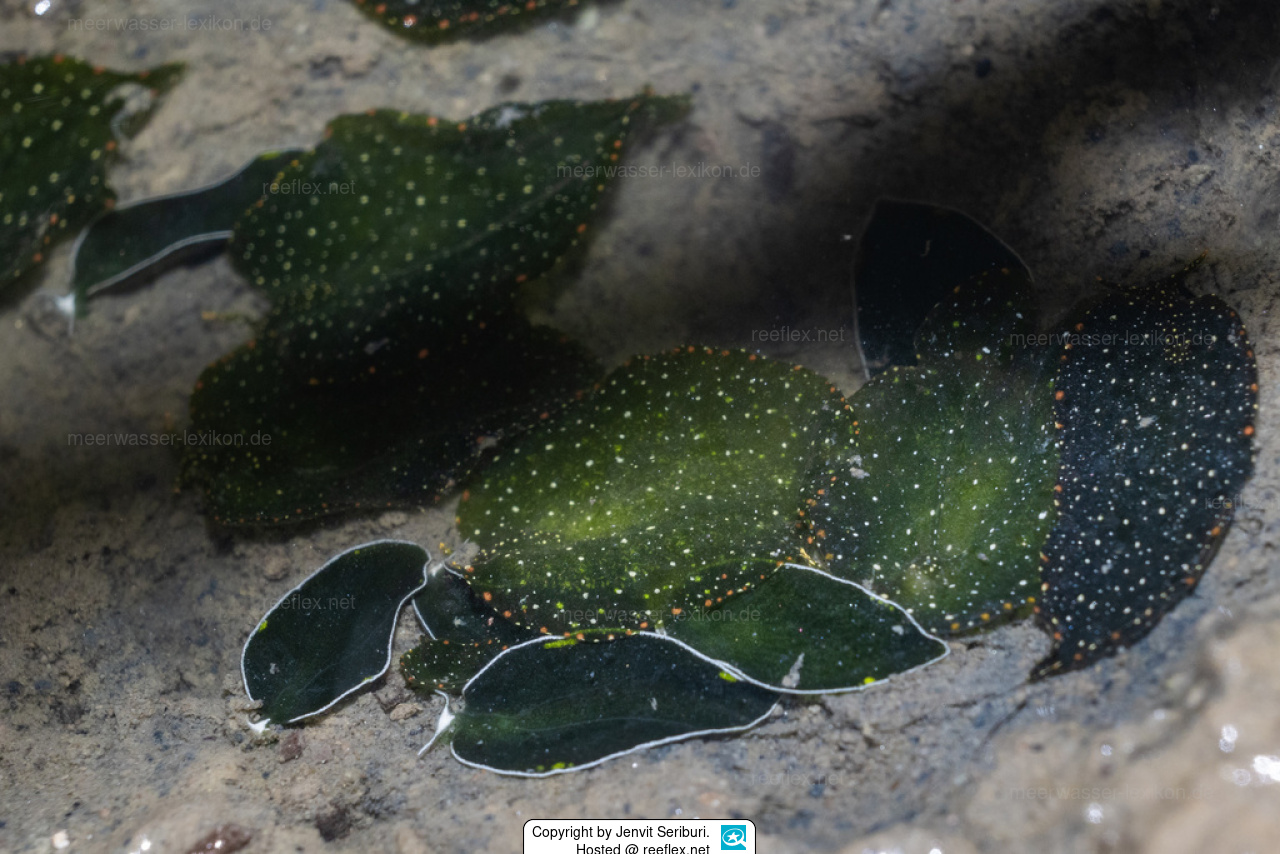
Elysia leucolegnote White edged Elysia, Mangrove Leaf Slug

Elysia leucolegnote is commonly referred to as White edged Elysia, Mangrove Leaf Slug. Difficulty in the aquarium: Not suitable for aquarium keeping. Toxicity: Toxic hazard unknown.


Profilbild Urheber Jenvit Seriburi

Elysia leucolegnote,Together with E. bangtawaensis,Bana, Mueang Pattani District, Pattani, TH 2026


Courtesy of the author Jenvit Seriburi Jenvit Seriburi. Please visit www.inaturalist.org for more information.

Uploaded by Muelly.

Image detail


Profile

lexID:
18164 
AphiaID:
494456 
Scientific:
Elysia leucolegnote 
German:
Weißrand Elysia, Mangroven Blatt Saftsauger 
English:
White Edged Elysia, Mangrove Leaf Slug 
Category:
Sacoglossa 
Family tree:
Animalia (Kingdom) > Mollusca (Phylum) > Gastropoda (Class) > Sacoglossa (Order) > Plakobranchidae (Family) > Elysia (Genus) > leucolegnote (Species) 
Initial determination:
K. R. Jensen, 1990 
Occurrence:
Hong Kong, Andaman and Nicobar Islands, Australia, Indonesia, Philippines, Queensland (Australia), Singapore, South-Pazific, Thailand 
Marine Zone:
Intertidal (Eulittoral), intertidal zone between the high and low tide lines characterized by the alternation of low and high tide down to 15 meters 
Sea depth:
- 0,20 Meter 
Habitats:
Brackish water, Mangrove Zones, Seawater, Sea water, Unconsolidated muddy grounds 
Size:
up to 1.57" (4 cm) 
Temperature:
°F - 82.4 °F (°C - 28°C) 
Food:
Algae (Algivore), Herbivorous 
Difficulty:
Not suitable for aquarium keeping 
Offspring:
None 
Toxicity:
Toxic hazard unknown 
CITES:
Not evaluated 
Red List:
Not evaluated (NE) 
Related species at
Catalog of Life:
 
More related species
in this lexicon:
 
Author:
Publisher:
Meerwasser-Lexikon.de
Created:
Last edit:
2026-02-17 16:26:23 

Info

Elysia leucolegnote K. R. Jensen, 1990

Members of genus Elysia feed primilary by piercing and sucking algae cells (chloroplasts).They are sap Sucking Slugs.Thats why Elysia is,like their food, often green.Young species are brownish or beige in colour.

External links

  1. ntfieldnaturalists.org. (en). Abgerufen am 17.02.2026.
  2. researchgate (en). Abgerufen am 17.02.2026.
  3. Sea Slug Forum (en). Abgerufen am 17.02.2026.
  4. Wikipedia (de). Abgerufen am 17.02.2026.

Pictures

Commonly


Husbandry know-how of owners

0 husbandary tips from our users available
Show all and discuss