


 iNaturalist Open Source Software

Info
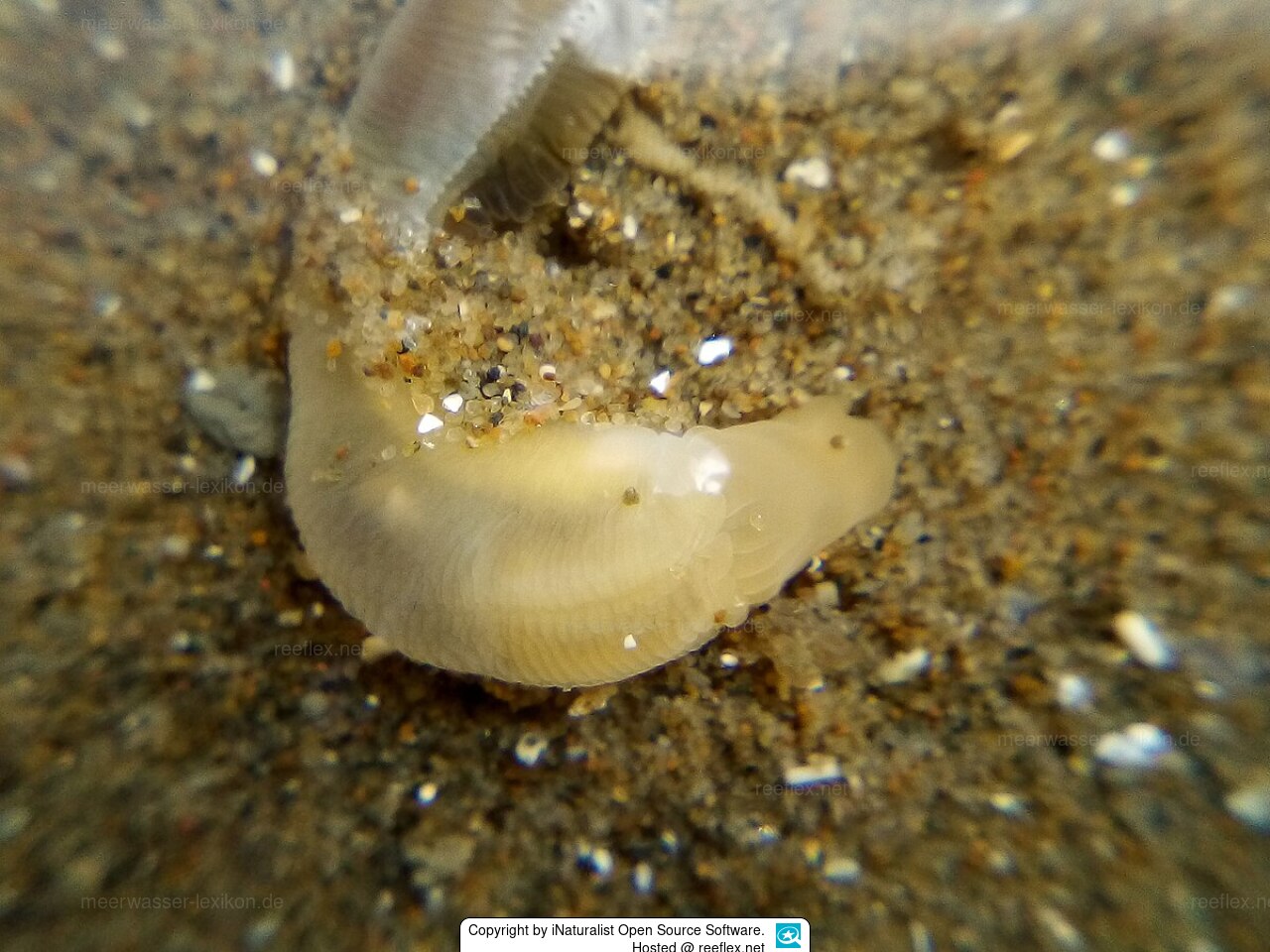
Balanoglossus australiensis is a 20-centimeter-long acorn worm species from the Ptychoderidae family, which is found in the Gulf of Carpentaria, northern Australia, New Zealand, western Australian cities such as Hawkesbury and Manning, and the Solomon Islands and its surrounding seas.
Its habitat consists of sandy burrows 200 to 250 mm deep.
In sheltered bays on the sandy Pacific coast of Auckland, New Zealand, populations of Balanoglossus australiensis have been found to reproduce vegetatively. Juvenile worms with a length of 2 to 10 mm are formed from the genital area of the trunk of adult (approx. 20 cm) individuals.
Vegetative division occurs when fragments are separated from the rear end of the front half of a worm that has already broken into two parts just before the first hepatic cecum.
The small fragments (regenerands) possess all the structures that were originally present at this level (between the gill and liver areas) of the mother's body from which they split off, but the typical arrangement of the adults is altered by stretching.
The development of the complete specific form occurs through redifferentiation of the proboscis, collar, gills, liver cecum, etc., in accordance with the known regenerative properties of Enteropneusta.
In the meantime, the new balanoglossids remain in the parent trench, after which the growing individuals dig their own trenches.
The sandy substrate is probably important for the conditions under which vegetative reproduction takes place.
The period during which it occurs overlaps with the period during which mature germ cells are present, but the relative role of sexual and asexual reproduction is not yet clear. No generational succession has been observed.
Knowledge about Balanoglossus australiensis does not yet seem to be fully established:
Ubius hilli was described as a parasite of Balanoglossus australiensis Hill, 1894 ( Ptychodera australis or Ptychodera australiensis) in Australian waters (Kesteven, 1913), see https://www.journals.uchicago.edu/doi/full/10.1086/BBLv226n1p69, while the Atlas of Living Australia lists Ubius hilli as food for the acorn worm https://bie.ala.org.au/species/ https://biodiversity.org.au/afd/taxa/14cdcb48-d051-4811-9d0e-5db0cf324446
Its habitat consists of sandy burrows 200 to 250 mm deep.
In sheltered bays on the sandy Pacific coast of Auckland, New Zealand, populations of Balanoglossus australiensis have been found to reproduce vegetatively. Juvenile worms with a length of 2 to 10 mm are formed from the genital area of the trunk of adult (approx. 20 cm) individuals.
Vegetative division occurs when fragments are separated from the rear end of the front half of a worm that has already broken into two parts just before the first hepatic cecum.
The small fragments (regenerands) possess all the structures that were originally present at this level (between the gill and liver areas) of the mother's body from which they split off, but the typical arrangement of the adults is altered by stretching.
The development of the complete specific form occurs through redifferentiation of the proboscis, collar, gills, liver cecum, etc., in accordance with the known regenerative properties of Enteropneusta.
In the meantime, the new balanoglossids remain in the parent trench, after which the growing individuals dig their own trenches.
The sandy substrate is probably important for the conditions under which vegetative reproduction takes place.
The period during which it occurs overlaps with the period during which mature germ cells are present, but the relative role of sexual and asexual reproduction is not yet clear. No generational succession has been observed.
Knowledge about Balanoglossus australiensis does not yet seem to be fully established:
Ubius hilli was described as a parasite of Balanoglossus australiensis Hill, 1894 ( Ptychodera australis or Ptychodera australiensis) in Australian waters (Kesteven, 1913), see https://www.journals.uchicago.edu/doi/full/10.1086/BBLv226n1p69, while the Atlas of Living Australia lists Ubius hilli as food for the acorn worm https://bie.ala.org.au/species/ https://biodiversity.org.au/afd/taxa/14cdcb48-d051-4811-9d0e-5db0cf324446

