

 Gemeinfreies Foto / Public Domain

Info
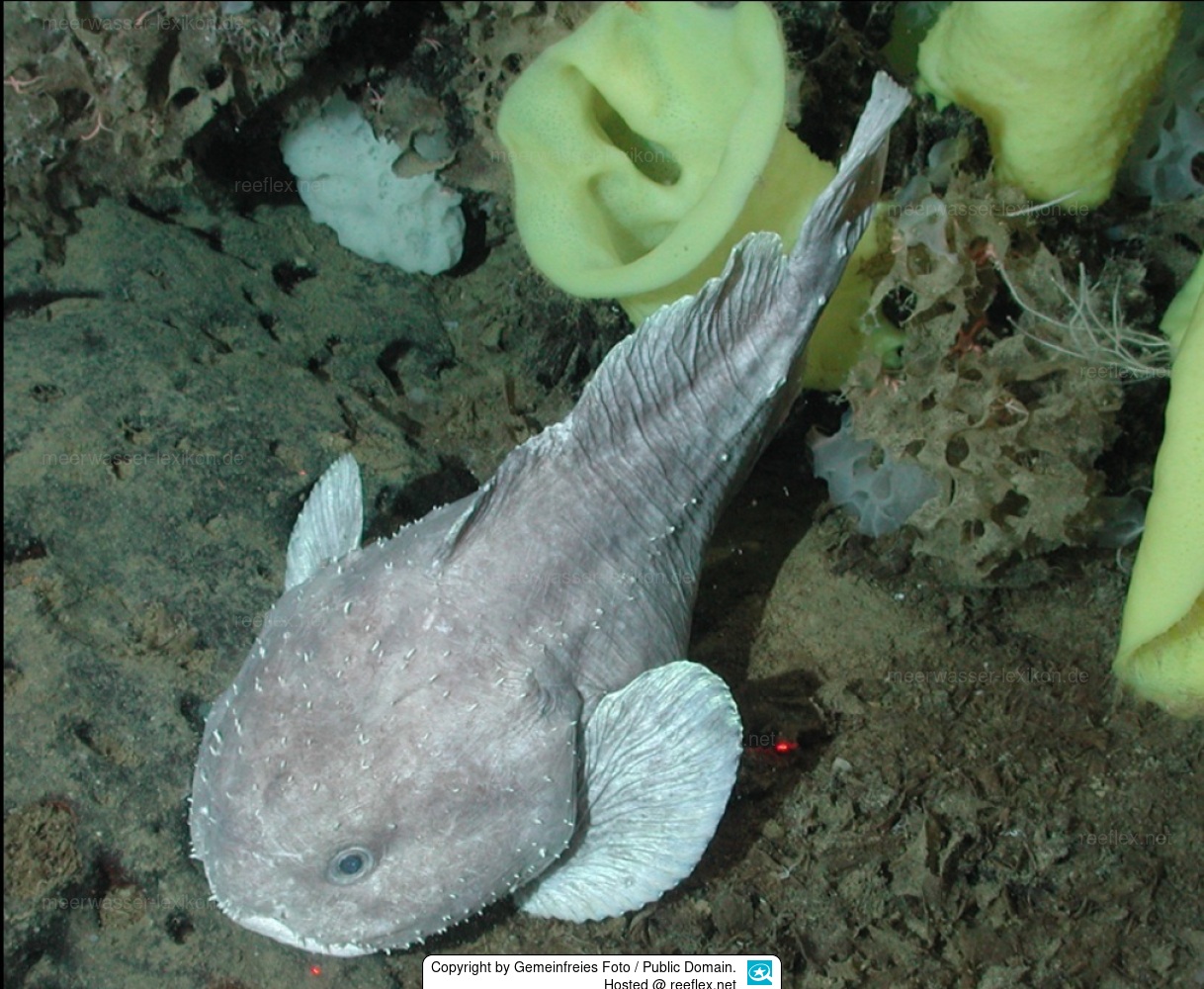
Photos of living fish from the deep sea, such as Psychrolutes phrictus, only reach the public through the use of deep-sea-capable underwater vehicles such as ROVs.
Through collaborations such as this one between the National Oceanic and Atmospheric Administration (NOAA) and the Monterey Bay Aquarium Research Institute (MBARI) in California, photos of the most incredible sea creatures are repeatedly brought to the attention of scientists and interested laypeople.
Dead animals are repeatedly landed by deep-sea fishing.
One of these dead animals was voted “world's ugliest animal” in 2013 because the fish looks like “a bald, old man who is struggling with life.”
https://www.nzz.ch/panorama/blobfisch-zum-haesslichsten-tier-der-welt-gekuert-ld.722173
One of the reasons for its appearance and the influence of gravity is its jelly-like body structure on the surface, which resembles a jellyfish-like creature.
Deep-sea creatures must possess a special characteristic by nature in order to withstand the water pressure that prevails there.
At the deepest point of 2800 meters, the water pressure is 280 bar, which corresponds to 2800 tons per square meter or 280 kg per square centimeter!
The elastic body of Psychrolutes phrictus seems to be ideally adapted to the pressure.
The largest specimens of Psychrolutes phrictus discovered often have ring-shaped patterns that could originate from the suction cups of the tentacles of squids or octopuses, as they also do from
Through collaborations such as this one between the National Oceanic and Atmospheric Administration (NOAA) and the Monterey Bay Aquarium Research Institute (MBARI) in California, photos of the most incredible sea creatures are repeatedly brought to the attention of scientists and interested laypeople.
Dead animals are repeatedly landed by deep-sea fishing.
One of these dead animals was voted “world's ugliest animal” in 2013 because the fish looks like “a bald, old man who is struggling with life.”
https://www.nzz.ch/panorama/blobfisch-zum-haesslichsten-tier-der-welt-gekuert-ld.722173
One of the reasons for its appearance and the influence of gravity is its jelly-like body structure on the surface, which resembles a jellyfish-like creature.
Deep-sea creatures must possess a special characteristic by nature in order to withstand the water pressure that prevails there.
At the deepest point of 2800 meters, the water pressure is 280 bar, which corresponds to 2800 tons per square meter or 280 kg per square centimeter!
The elastic body of Psychrolutes phrictus seems to be ideally adapted to the pressure.
The largest specimens of Psychrolutes phrictus discovered often have ring-shaped patterns that could originate from the suction cups of the tentacles of squids or octopuses, as they also do from


