


 Zoosystematics and Evolution (Pensoft)


Info
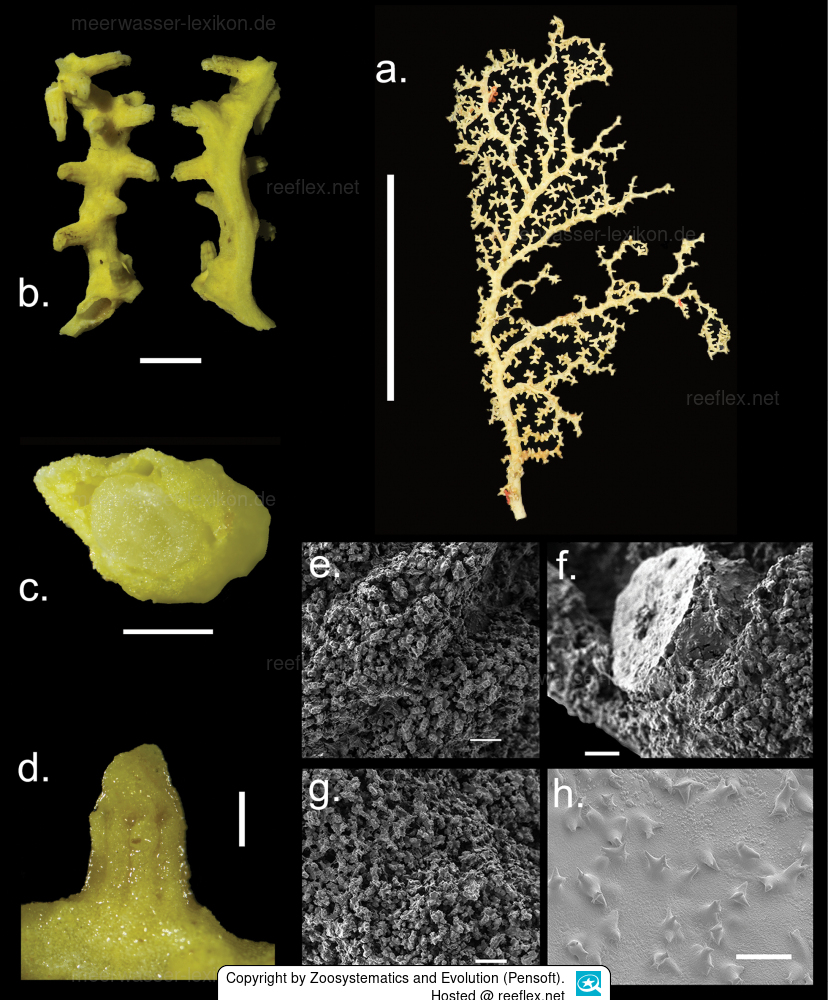
The yellowish coral pictured is a partial colony consisting of a branch with a broken edge on the stem, collected on 13 June 2022 at Carlsberg Ridge in the western Indian Ocean at a depth of 1696 meters.
Due to the uncontrollable nature of specimen collection and preservation in the deep sea, a more detailed examination of another suspect specimen could not be carried out and therefore no paratype was identified.
The specimen shown is a branch of the colony that is approximately 22 cm tall, with the base being the thickest at approximately 0.6 cm in diameter.
All branches show dichotomous branching in one plane, the branches are slightly curved, with many thinner branchlets appearing.
There are remnants of tissue where a brittle star had coiled around the branches (the brittle star was removed).
Color:
On underwater videos in situ, Hemicorallium jiaolongensis appears white to light yellow. The base of the colony is white.
When collected and brought on board, the fresh coenenchyma is pale yellow, the axis appears translucent milky white, and the sclerites appear pale red under the microscope.
Etymology:
The species name “jiaolongensis” was named in recognition of the manned submersible “Jiaolong”, which was instrumental in collecting these specimens.
The name honors the dedication and efforts of the Jiaolong crew during the scientific expedition in the western Indian Ocean.
Literature reference:
Hu X, Zhang Q, Ge M, Li X, Wang Z, Zhang X, Xu Q (2025)
Two new species of deep-sea Red Corals (Coralliidae, Genus Hemicorallium Gray, 1867) from the western Indian Ocean. Zoosystematics and Evolution
101(1): 317-339. https://doi.org/10.3897/zse.101.139350
This is an open access article distributed under the terms of the Creative Commons Attribution License (CC BY 4.0), which permits unrestricted use, distribution, and reproduction in any medium, provided the original author and source are credited.
Due to the uncontrollable nature of specimen collection and preservation in the deep sea, a more detailed examination of another suspect specimen could not be carried out and therefore no paratype was identified.
The specimen shown is a branch of the colony that is approximately 22 cm tall, with the base being the thickest at approximately 0.6 cm in diameter.
All branches show dichotomous branching in one plane, the branches are slightly curved, with many thinner branchlets appearing.
There are remnants of tissue where a brittle star had coiled around the branches (the brittle star was removed).
Color:
On underwater videos in situ, Hemicorallium jiaolongensis appears white to light yellow. The base of the colony is white.
When collected and brought on board, the fresh coenenchyma is pale yellow, the axis appears translucent milky white, and the sclerites appear pale red under the microscope.
Etymology:
The species name “jiaolongensis” was named in recognition of the manned submersible “Jiaolong”, which was instrumental in collecting these specimens.
The name honors the dedication and efforts of the Jiaolong crew during the scientific expedition in the western Indian Ocean.
Literature reference:
Hu X, Zhang Q, Ge M, Li X, Wang Z, Zhang X, Xu Q (2025)
Two new species of deep-sea Red Corals (Coralliidae, Genus Hemicorallium Gray, 1867) from the western Indian Ocean. Zoosystematics and Evolution
101(1): 317-339. https://doi.org/10.3897/zse.101.139350
This is an open access article distributed under the terms of the Creative Commons Attribution License (CC BY 4.0), which permits unrestricted use, distribution, and reproduction in any medium, provided the original author and source are credited.


