


 Dr. Gerald (Gerry) Robert Allen, Australien

Info
Leiognathus equula is a shallow, demersal fish that is usually found in estuaries and muddy coastal areas, often in mangrove areas.
Adult fish are coastal dwellers that generally stay above soft ground.
Adults move in schools and are known to frequently ascend into freshwater areas of rivers.
Juveniles are often found in mangrove estuaries and tidal creeks and sometimes enter the lower reaches of freshwater rivers
Leiognathus equula is mainly active during the day.
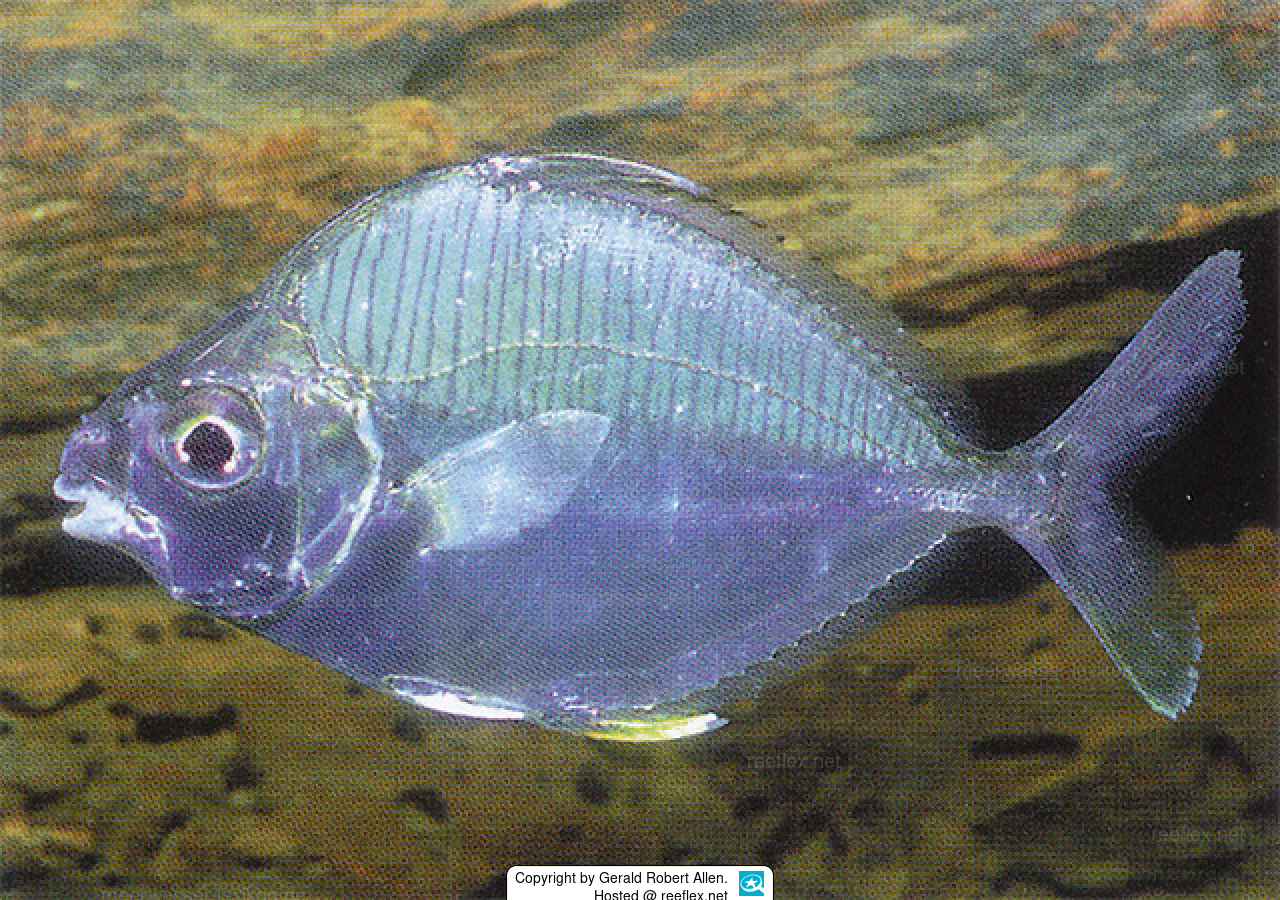
Leiognathus equula has a very deep and compressed body with a strongly humped back.
The head and breast are scaleless.
Adult fish have a gray back and a silvery belly with closely spaced faint stripes on the back and sides.
There is a dark brown saddle on the caudal peduncle and the axils of the pectoral fins are gray to black. The edge of the soft dorsal fin is also black.
In juveniles (5-7 cm TL), thin, closely spaced, gray vertical lines run from the back down to about mid-height, and the membrane between the anal fin spines is strikingly yellow.
Synonyms:
Equula caballa Valenciennes, 1835 · unaccepted
Equula edentula (Bloch, 1795) · unaccepted
Equula ensifera Cuvier, 1829 · unaccepted
Equula totta Cuvier, 1829 · unaccepted
Leiognathus argenteus Lacepède, 1802 · unaccepted
Leiognathus edentulus (Bloch, 1795) · unaccepted
Leiognathus equulus (Forsskål, 1775) · unaccepted (Specific epithet 'equula' a noun...)
Leiognathus obscura Seale, 1901 · unaccepted
Scomber edentulus Bloch, 1795 · unaccepted
Scomber equula Forsskål, 1775 · unaccepted
Adult fish are coastal dwellers that generally stay above soft ground.
Adults move in schools and are known to frequently ascend into freshwater areas of rivers.
Juveniles are often found in mangrove estuaries and tidal creeks and sometimes enter the lower reaches of freshwater rivers
Leiognathus equula is mainly active during the day.
Leiognathus equula has a very deep and compressed body with a strongly humped back.
The head and breast are scaleless.
Adult fish have a gray back and a silvery belly with closely spaced faint stripes on the back and sides.
There is a dark brown saddle on the caudal peduncle and the axils of the pectoral fins are gray to black. The edge of the soft dorsal fin is also black.
In juveniles (5-7 cm TL), thin, closely spaced, gray vertical lines run from the back down to about mid-height, and the membrane between the anal fin spines is strikingly yellow.
Synonyms:
Equula caballa Valenciennes, 1835 · unaccepted
Equula edentula (Bloch, 1795) · unaccepted
Equula ensifera Cuvier, 1829 · unaccepted
Equula totta Cuvier, 1829 · unaccepted
Leiognathus argenteus Lacepède, 1802 · unaccepted
Leiognathus edentulus (Bloch, 1795) · unaccepted
Leiognathus equulus (Forsskål, 1775) · unaccepted (Specific epithet 'equula' a noun...)
Leiognathus obscura Seale, 1901 · unaccepted
Scomber edentulus Bloch, 1795 · unaccepted
Scomber equula Forsskål, 1775 · unaccepted

