





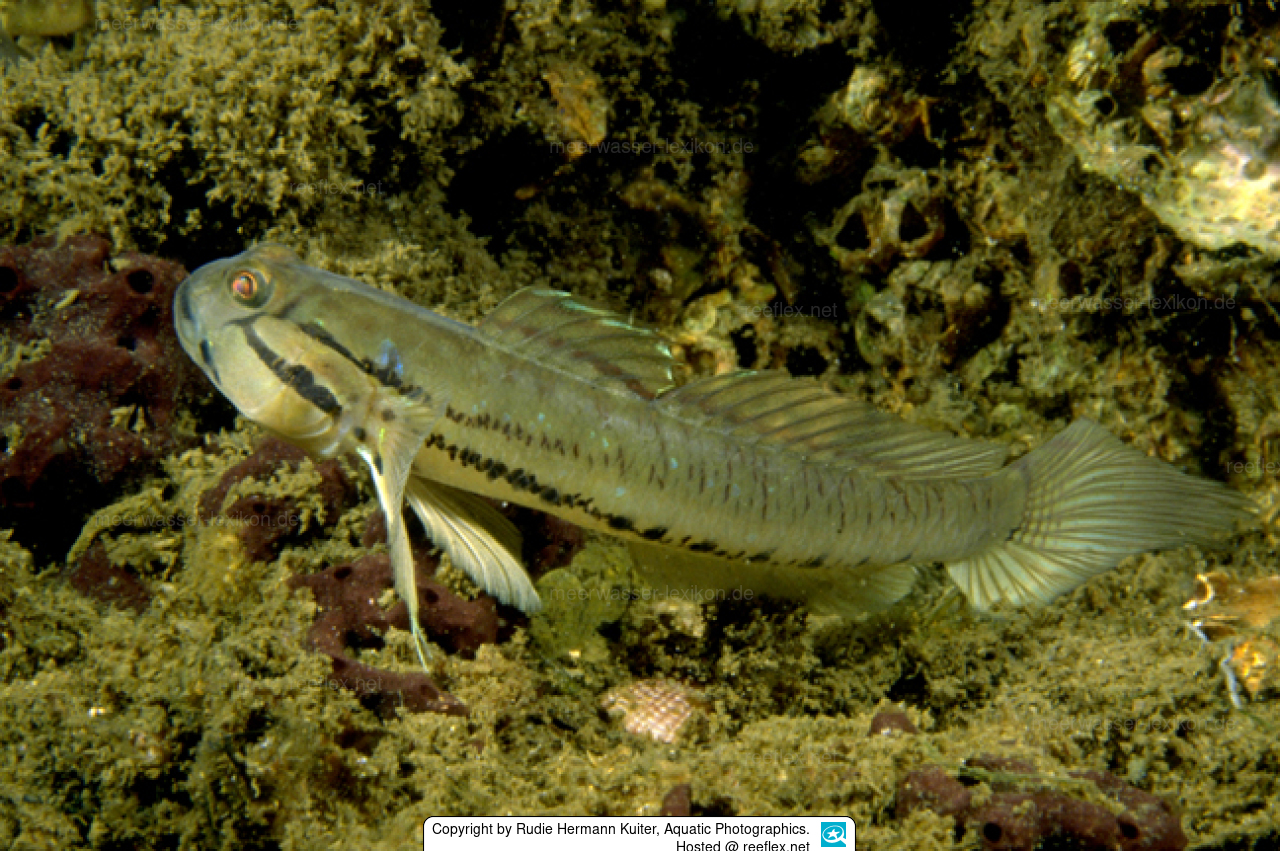
 Rudie Hermann Kuiter, Aquatic Photographics, Australien


Info
Arenigobius bifrenatus (Kner, 1865)
Arenigobius bifrenatus is a medium-sized goby with two oblique dark bands beginning at the head. The upper band crosses the gill cover and runs horizontally along the midlateral sides, at least to below the first dorsal fin. The lower band runs from below the eye through the pectoral fin base to the undersides, resolving into diffuse purplish-brown spots above the anal fin. Males have an elongated caudal fin.
Pairs of bridle goby live in burrows on sandy, silty, or muddy bottoms in the upper reaches of bays and estuaries near seagrass beds in bays, harbors, and coastal lagoons.
Overall, the goby is gray to pale olive-brown with iridescent pale blue spots along the sides of the body.
The menu of the goby includes benthic invertebrates.
Females lay their eggs in burrows, juveniles of Arenigobius bifrenatus are similar to those of Arenigobius frenatus. They are similar in color, and the caudal fin is short and rounded in both species.
Arenigobius bifrenatus differs from Arenigobius frenatus in the absence of dark spots on the head, the dark stripe that runs from the base of the pectoral fin across the underside of the body, resolving into a series of irregular spots, and the elongated caudal fin of adults.
Jumping guard
A jumping guard prevents (nocturnal) fish from jumping out.
Wrasses, blennies, hawkfishs and gobies jump out of an unprotected tank in fright if their night rest is disturbed, unfortunately these jumpers are found dried up in the morning on carpets, glass edges or later behind the tank.
https://www.korallenriff.de/en/article/1925_5_Jump_Protection_Solutions_for_Fish_in_the_Aquarium__5_Net_Covers.html
A small night light also helps, as it provides the fish with a means of orientation in the dark!
Synonymised names
Acentrogobius bifrenatus (Kner, 1865) · unaccepted (synonym)
Gobius bassensis Castelnau, 1872 · unaccepted
Gobius bifrenatus Kner, 1865 · unaccepted
Gobius castelnaui MacLeay, 1881 · unaccepted
Gobius caudatus Castelnau, 1873 · unaccepted
Gobius filamentosus Castelnau, 1875 · unaccepted
Gobius infaustus Sauvage, 1880 · unaccepted
Arenigobius bifrenatus is a medium-sized goby with two oblique dark bands beginning at the head. The upper band crosses the gill cover and runs horizontally along the midlateral sides, at least to below the first dorsal fin. The lower band runs from below the eye through the pectoral fin base to the undersides, resolving into diffuse purplish-brown spots above the anal fin. Males have an elongated caudal fin.
Pairs of bridle goby live in burrows on sandy, silty, or muddy bottoms in the upper reaches of bays and estuaries near seagrass beds in bays, harbors, and coastal lagoons.
Overall, the goby is gray to pale olive-brown with iridescent pale blue spots along the sides of the body.
The menu of the goby includes benthic invertebrates.
Females lay their eggs in burrows, juveniles of Arenigobius bifrenatus are similar to those of Arenigobius frenatus. They are similar in color, and the caudal fin is short and rounded in both species.
Arenigobius bifrenatus differs from Arenigobius frenatus in the absence of dark spots on the head, the dark stripe that runs from the base of the pectoral fin across the underside of the body, resolving into a series of irregular spots, and the elongated caudal fin of adults.
Jumping guard
A jumping guard prevents (nocturnal) fish from jumping out.
Wrasses, blennies, hawkfishs and gobies jump out of an unprotected tank in fright if their night rest is disturbed, unfortunately these jumpers are found dried up in the morning on carpets, glass edges or later behind the tank.
https://www.korallenriff.de/en/article/1925_5_Jump_Protection_Solutions_for_Fish_in_the_Aquarium__5_Net_Covers.html
A small night light also helps, as it provides the fish with a means of orientation in the dark!
Synonymised names
Acentrogobius bifrenatus (Kner, 1865) · unaccepted (synonym)
Gobius bassensis Castelnau, 1872 · unaccepted
Gobius bifrenatus Kner, 1865 · unaccepted
Gobius castelnaui MacLeay, 1881 · unaccepted
Gobius caudatus Castelnau, 1873 · unaccepted
Gobius filamentosus Castelnau, 1875 · unaccepted
Gobius infaustus Sauvage, 1880 · unaccepted


