


 Prof. Dr. Nur Eda TOPÇU ERYALÇIN, Türkei


Info
Spinimuricea klavereni (Karpine and Grasshoff, 1975) is described in many sources as a living species endemic to the Mediterranean.
We owe Prof. Dr. Nur Eda Topçu Eryalçin, the leading specialist for Sinimuricea ,through her research in the Sea of Marmara and the Black Sea, for confirming the presence of the gorgonian in relatively shallow water zones:
Six colonies have been studied at depths of 25-38 metres, other colonies in Spain at 23-45 metres.
The deepest evidence of the gorgonian in the Mediterranean was 130 metres.
The IUCN Red List of Threatened Species indicates a maximum depth of 1000 metres.
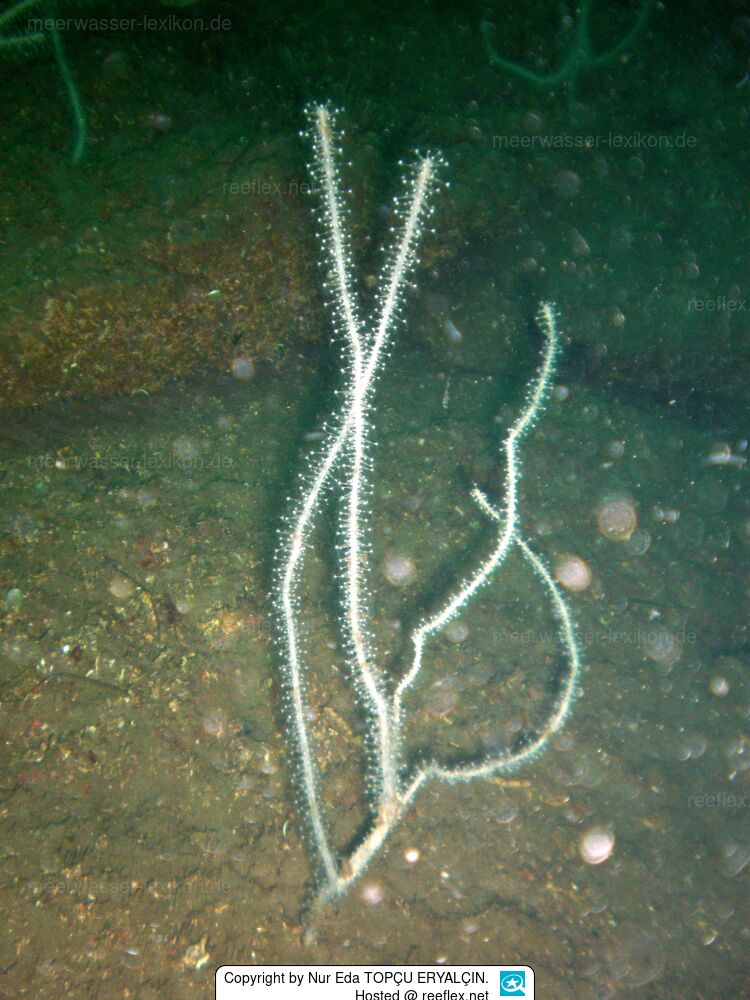
The investigated Spinimuricea klavereni colonies were long and elegant, white, unbranched or showed very few branched branches.
Habitat: on rocky soils and on stone/shells on muddy soils, on rocky outcrops
Recommendation - the coral should be kept in a species-specific tank.
Feeding
The majority of gorgonians do not have zooxanthellae and do not live off light. Azooxanthellate gorgonians do not host symbiotic algae that produce nutrients and energy through photosynthesis.
The pumps should be switched off before feeding. In order for the gorgonian to survive in the aquarium, each individual polyp must be fed sufficiently, i.e. daily or 3-4 times a week. Without feeding, the gorgonian will not survive in the aquarium. The polyps need a certain amount of time to absorb the food (granules or dust food (Ultramarin, Cyclop Eeze) or frozen food (lobster eggs, mysis)). If shrimp and fish are present, they will try to steal the food, so it is essential to feed these cohabitants beforehand.
Newly introduced gorgonian sticks can be stimulated with a liquid food, e.g., PolypLab Polyp, to encourage the individual polyps to open. Only then can feeding be carried out.
The better the individual polyps take up the food provided, the better the growth and reproduction rates will be.
Azooxanthellate corals eat suspensions, marine snow, microplankton, and other organic matter, which is their natural food.
Notes on water temperature:
In the Sea of Marmara, temperature differences are very small below 20 m, and the temperature is generally around 15°C. Therefore, gorgonians do not risk mortality events due to thermal stress as in the Mediterranean Sea
Since Spinimuricea klavereni is a less common coral, areas such as the Sea of Marmara should be particularly protected.
Synonym: Echinomuricea klavereni Carpine & Grasshoff, 1975
We owe Prof. Dr. Nur Eda Topçu Eryalçin, the leading specialist for Sinimuricea ,through her research in the Sea of Marmara and the Black Sea, for confirming the presence of the gorgonian in relatively shallow water zones:
Six colonies have been studied at depths of 25-38 metres, other colonies in Spain at 23-45 metres.
The deepest evidence of the gorgonian in the Mediterranean was 130 metres.
The IUCN Red List of Threatened Species indicates a maximum depth of 1000 metres.
The investigated Spinimuricea klavereni colonies were long and elegant, white, unbranched or showed very few branched branches.
Habitat: on rocky soils and on stone/shells on muddy soils, on rocky outcrops
Recommendation - the coral should be kept in a species-specific tank.
Feeding
The majority of gorgonians do not have zooxanthellae and do not live off light. Azooxanthellate gorgonians do not host symbiotic algae that produce nutrients and energy through photosynthesis.
The pumps should be switched off before feeding. In order for the gorgonian to survive in the aquarium, each individual polyp must be fed sufficiently, i.e. daily or 3-4 times a week. Without feeding, the gorgonian will not survive in the aquarium. The polyps need a certain amount of time to absorb the food (granules or dust food (Ultramarin, Cyclop Eeze) or frozen food (lobster eggs, mysis)). If shrimp and fish are present, they will try to steal the food, so it is essential to feed these cohabitants beforehand.
Newly introduced gorgonian sticks can be stimulated with a liquid food, e.g., PolypLab Polyp, to encourage the individual polyps to open. Only then can feeding be carried out.
The better the individual polyps take up the food provided, the better the growth and reproduction rates will be.
Azooxanthellate corals eat suspensions, marine snow, microplankton, and other organic matter, which is their natural food.
Notes on water temperature:
In the Sea of Marmara, temperature differences are very small below 20 m, and the temperature is generally around 15°C. Therefore, gorgonians do not risk mortality events due to thermal stress as in the Mediterranean Sea
Since Spinimuricea klavereni is a less common coral, areas such as the Sea of Marmara should be particularly protected.
Synonym: Echinomuricea klavereni Carpine & Grasshoff, 1975


